

Solo founder or business partners: which one are you? Your answer determines whether you need a single-member LLC, with one sole owner calling all the shots, or a multi-member LLC, where two or more owners share the responsibilities, profits, and decisions.
It sounds simple, but the structure you pick affects your taxes, your personal asset protection, and how your business operates every single day.
MyLLC has helped thousands of entrepreneurs sort this out. This guide breaks down exactly what you need to know to choose the right structure from day one.

Single-member LLCs have one owner; multi-member LLCs have two or more.
Both structures offer limited liability protection for personal assets.
Tax treatment differs depending on the number of members and IRS classification.
Multi-member LLCs require more coordination, documentation, and filing requirements.
Married couples may qualify for special tax treatment depending on their state.
Your ownership goals, tax preferences, and growth plans should drive the decision.
Here’s a quick comparison to help you see the key differences side by side:
| Feature | Single-Member LLC | Multi-Member LLC |
|---|---|---|
| Number of Owners | 1 owner | 2 or more owners |
| Default Tax Status | Disregarded entity (taxed like sole proprietor) | Partnership (pass-through) |
| EIN Requirement | Needed if employees or certain tax elections | Needed to file partnership return |
| Tax Filing | On owner's Form 1040 (usually Schedule C) | Form 1065 plus Schedule K-1 for each member |
| Decision Making | One person controls decisions | Shared control per operating agreement |
| Profit Distribution | All profits to the single owner | Profits split per operating agreement |
| Operating Agreement | Recommended | Strongly recommended / essential |
| Growth & Investors | Best for solo operators | Better for partners and adding new investors |
A single-member LLC is a limited liability company with exactly one member as the sole owner. As a business entity, it gives you personal asset protection without the complexity of managing multiple owners.
The sole owner controls all business operations. Single-member LLCs typically require less complex management structures than multi-owner businesses, and as a separate legal entity, the LLC keeps personal assets protected from business debts.
Easy decision-making. No waiting on a partner. You move fast.
Simplified tax filing. Your LLC is a disregarded entity by default, so business income flows to Schedule C on your personal return.
Lower compliance costs. Single-member LLCs generally have simpler compliance requirements and lower administrative burdens than multi-member structures.
Complete control. You own 100% of the profits and call all the shots.
Limited access to capital. Lenders and investors may be more cautious with a single-owner business.
Sole responsibility. Every task, every problem, and every decision falls on you.
Higher piercing risk. Single-member LLCSs face a higher risk of losing liability protection compared to multi-member LLCs, especially when personal and business funds are mixed.
A multi-member LLC has two or more owners. Each member holds membership interests in the business, recorded in the operating agreement. It's common among business partners, families, and investors who want to share resources and run a company under one business name.
Multi-member LLCs require collaboration among owners. In a member managed LLC, all members participate in management. The operating agreement defines how decisions are made, profits are split, and what happens when a member exits.
Shared expertise. Different members bring different skills to the table.
Greater funding opportunities. Multiple owners often means more capital to start and grow.
Distributed workload. You don’t have to carry the entire business on your own.
Stronger credibility. Some clients and lenders view multi-member LLCs as more established.
Potential disputes. Partners don’t always agree, and disagreements can slow things down.
More complex management. Shared decision-making takes more time and communication.
Additional tax filing requirements. Multi member LLCs require a separate tax return and K-1s issued to each member.
Higher compliance costs. Multi-member LLCs face higher compliance costs due to additional tax filings and record-keeping requirements.
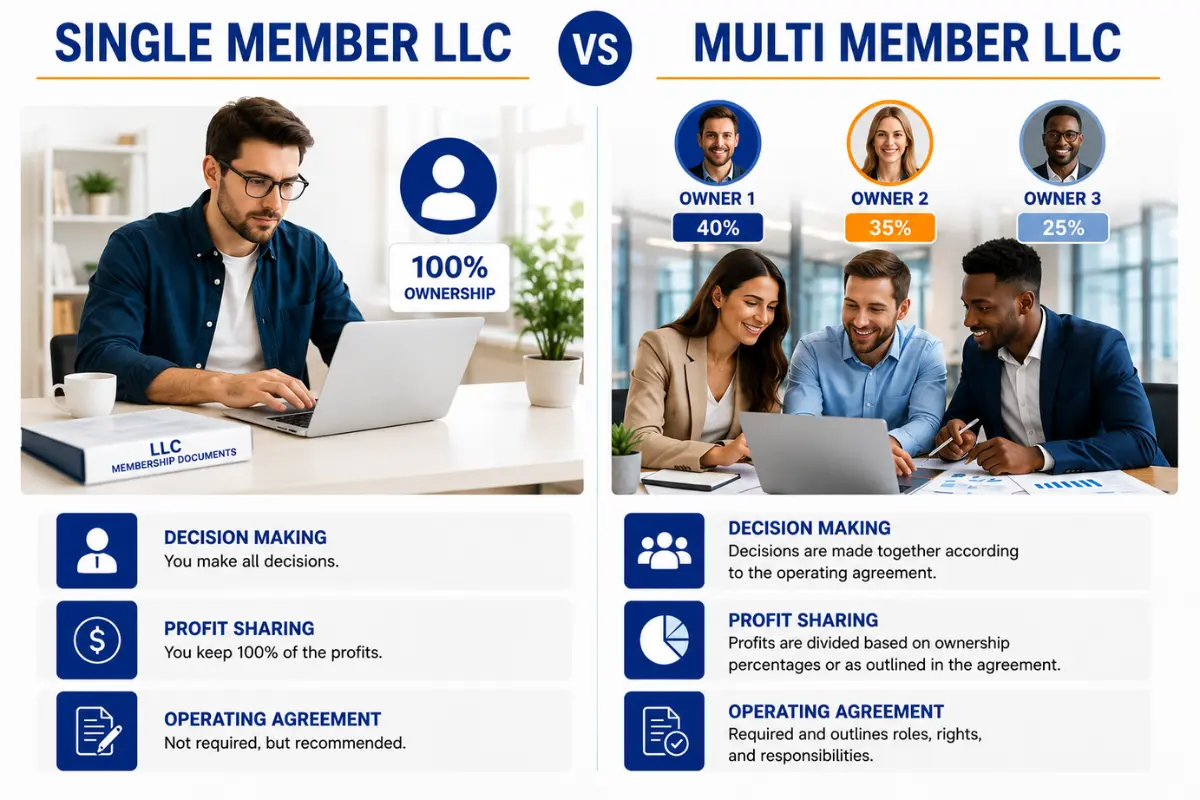
A single-member LLC has one member as sole owner. A multi-member LLC has two or more owners, with multiple members each holding a stake. Unlike a sole proprietorship, both structures provide liability protection, with ownership percentages recorded in the operating agreement.
Single-member LLCs have one member making all decisions and typically require less complex management structures. Multi-member LLCs can be a member managed LLC, where all members participate in management, or a manager managed LLC where a designated person handles operations. Multi-member LLCs require shared management and decision-making, which takes more coordination but distributes the workload.
In a single-member LLC, all profits go to the sole owner. In a multi-member LLC, the operating agreement determines how the LLC’s profits are split, either equally or based on each member’s ownership percentage.
Every LLC benefits from a solid LLC operating agreement. LLCs must maintain company records like operating agreements to stay compliant, and failure to comply with LLC rules can lead to penalties. For multi-member LLCs, the agreement is essential, covering ownership percentages, voting rights, and exit terms.
Both structures offer strong personal liability protection for LLC members. Whether you’re forming a single-member or multiple member LLC, your personal assets are shielded from business debts. Choosing an LLC business structure over a sole proprietorship means your personal assets stay separate from business liabilities, though this protection isn’t absolute.
The U.S. Small Business Administration explains that LLCs help protect owners from personal liability for many business debts and obligations, which is one of the primary reasons entrepreneurs choose this business structure.
Single-member LLCs face a higher risk of losing liability protection compared to Multi-member LLCs, which benefit from charging order protections that shield assets from personal debts. Mixing personal and business finances can destroy liability protection in either structure.
Multi-member LLCs often have a scaling advantage. More owners means more capital, broader networks, and greater capacity. Single-member LLCs can grow significantly too, but may face limits when it comes to raising capital.
According to the IRS, a limited liability company (LLC) is a business structure permitted under state law, and the way an LLC is taxed depends largely on the number of members it has and whether it elects a different tax classification.
Tax treatment is one of the biggest practical differences. Here’s how each works by default.
The IRS treats a single-member LLC as a disregarded entity for federal income tax purposes. Single-member LLCs do not pay corporate income tax. Single business owners and single member LLC owners report income on Schedule C of Form 1040.
Multi-member LLCs are taxed as partnerships by default. The LLC files IRS Form 1065, a partnership income return. Each of the LLC members receives a Schedule K-1 showing their share of the LLC’s profits, which they report on their own tax return.
For federal tax purposes, neither structure pays corporate income tax directly. Both are pass-through entities, so the LLC itself doesn’t pay federal income tax.
Yes. Both Single-member LLCs and Multi-member LLCs can elect to be taxed as S-Corporations or C-Corporations if they meet IRS requirements. An S-Corporation election can reduce self-employment taxes by allowing owners to take income as distributions rather than salary. Consult a tax professional to see if it’s right for your situation.
Here’s a side-by-side look at the pros and cons of each structure:
| Single-Member LLC | Multi-Member LLC | |
|---|---|---|
| PROS | ||
| Full control over decisions | Shared expertise and workload | |
| Simpler tax filing | Greater ability to pool capital | |
| Faster decisions and easier day-to-day management | More growth potential | |
| Lower internal administrative burden | Can appear more credible to lenders and investors | |
| CONS | ||
| Capital limited to one owner | Potential for member disputes | |
| Owner responsible for most or all tasks | More complex tax filing | |
| Liability protection depends on good records and formalities | Higher administrative and coordination burden | |
| May appear less established to some lenders or investors | Needs a strong, well-drafted operating agreement |
Yes, spouses can co-own an LLC. When both spouses are members, it's treated as a multi-member LLC by default, giving both partners equal standing and legal protection.
In community property states like California, Texas, and Arizona, spouses may qualify to file as separate disregarded entities instead of a partnership, eliminating the need for Form 1065.
In other states, couples file as a standard multi-member LLC using Form 1065. The IRS does allow a qualified joint venture election for spouses who both actively participate, which simplifies filing.
When one spouse owns the LLC and the other works as an employee, it remains a single-member LLC for tax purposes.
According to the IRS, certain single-member LLCs must obtain an Employer Identification Number (EIN), particularly if the business hires employees or elects to be taxed as a corporation.
You’ll need an employer identification number if your single-member LLC hires employees or elects corporate tax treatment. Multi-member LLCs almost always need one. When you file articles of organization or formation documents with your state, most states prompt you to obtain one, and you’ll need it to apply for necessary business licenses and register with a registered agent. Learn more about EIN requirements and when your business needs one.
A single-member LLC with no employees and no corporate tax election can use the owner’s Social Security Number, though most owners get an EIN anyway.
An EIN lets you open a business bank account, which is critical for keeping personal and business assets separate. It also protects your Social Security Number and adds credibility with clients and lenders.
In today’s business world, single business owners and multi-owner teams alike benefit from LLC protection. A solid business plan and the right structure go hand in hand. Check out our guides on whether an LLC is worth it or how to start an LLC to learn more.
You’re a solo entrepreneur or freelancer who wants complete control.
You prefer simple taxes and lower administrative burden.
You don’t plan to bring in partners or outside investors.
You’re starting a business with a partner, spouse, or investor.
You want to share the workload and raise capital together.
You’re planning fast growth and need more resources than one person can provide.
Both LLC types provide liability protection and flexible tax options, but serve different needs. A single-member LLC suits solo owners who want complete control, simpler taxes, and lower compliance costs. A multi-member LLC makes more sense when two or more owners are sharing resources, skills, and responsibility.
The right structure is the one that matches how your business is actually owned and how you plan to run it. Understanding that before you file saves you from costly changes down the road.
Forming an LLC doesn't have to be complicated. MyLLC handles the paperwork, filings, and compliance details so you can focus on your business. Whether you're going solo or starting with a partner, we make the process simple from start to finish.
Take the next step and form your LLC with MyLLC today. Contact us to get started.
Not necessarily. It depends on your goals. A multi-member LLC suits owners who want to share resources and expertise. A single-member LLC is better for solo owners who want simplicity and complete control.
More complexity: a separate Form 1065 return, Schedule K-1s for each member, a detailed operating agreement, and shared decision-making.
Greater court scrutiny on liability protection if personal and business finances are mixed, limited access to capital, and all management falls on one person.
As a partnership by default. The LLC files Form 1065 and issues K-1s to each member. Both S corp and C corp elections are also available.
Not always, but usually yes. You need one if you hire employees or elect corporate tax treatment. An EIN also lets you open a business bank account and protects your SSN.
Yes. In community property states, they may qualify as a qualified joint venture for simpler tax filing.
Yes. You'll need to update the operating agreement, amend your state registration, and change your IRS tax classification.
Single-member LLCs have simpler filing by default. Both benefit from pass-through taxation and can elect S corp status to reduce self employment tax. Talk to a tax professional for personalized guidance.