

Landing your first real client is exciting. Then they send over a W-9 and ask for your tax ID, and suddenly you are wondering whether to hand over your Social Security Number or whether you even need something called an EIN. If that moment sounds familiar, you are not alone. Most new business owners find out too late that not having an EIN can slow down their banking, expose their personal information on client paperwork, and create compliance headaches they never saw coming. Getting set up the right way from the start makes all the difference.
Some businesses are legally required to have one. Others can get by without one, at least for a while. But getting an EIN is usually the smarter move regardless, and we will explain exactly why. Whether you are forming an LLC, working as a sole proprietor, or opening a business bank account, this guide will help you figure out where you stand.

An EIN is a federal tax ID issued by the IRS and is commonly used to identify businesses for tax and banking purposes.
Most multi-member LLCs, corporations, partnerships, and businesses with employees are required to have an EIN.
Some sole proprietors and single-member LLCs may not legally need an EIN, but obtaining one can still provide privacy, banking, and credibility benefits.
Many banks require an EIN to open a business bank account, especially for LLCs and businesses planning to grow.
Using an EIN instead of your Social Security Number can help reduce identity theft risks and better separate personal and business finances.
The EIN application process is free through the IRS and can usually be completed online in minutes.
Choosing the right business structure can directly affect whether your business is required to obtain an EIN.
An EIN, or Employer Identification Number, is a unique nine-digit number issued by the IRS to identify a business entity for federal tax and reporting purposes. It works the same way a Social Security Number does for individuals. Just like your SSN identifies you as an individual taxpayer, an EIN identifies your business. While you can apply directly with the IRS using Form SS-4, many business owners choose to work with a professional service like MyLLC rather than navigating the application process on their own.
According to the IRS, an Employer Identification Number (EIN) is used to identify a business entity for federal tax purposes. That simple definition covers a lot of ground, from tax filings to payroll to banking.
An EIN is used across nearly every part of your business finances:
Filing federal and state business taxes
Hiring and paying employees
Opening a business bank account
Keeping your personal and business finances separate
Completing vendor contracts and 1099 paperwork
It is also what protects your personal Social Security Number from being handed out on every W-9 form you fill out for clients.
Not every business is legally required to have one, but many are. Here is the breakdown.
Businesses that typically need an EIN: Multi-member LLCs, corporations, partnerships, any business with employees, and businesses that file excise or payroll tax returns all need an EIN.
Businesses that may not legally need an EIN: Some sole proprietors with no employees can use their Social Security Number instead. The same goes for certain single-member LLCs with no payroll or excise taxes.
You likely need an EIN if you are:
Hiring employees or running payroll
Opening a business bank account
Electing S Corp tax status
Filing excise or payroll tax returns
If you have a single-member LLC, the IRS considers it a disregarded entity for federal income tax purposes by default. That means the IRS essentially looks through the LLC and taxes the owner directly. Because of that, an EIN is not always required.
The IRS notes that single-member LLCs are treated as disregarded entities for federal income tax purposes, but an EIN may still be required for employment taxes and banking. In practice, that means if you hire even one employee or open most business bank accounts, you will need one.
A multi-member LLC is a different story. Because the IRS treats it as a partnership for tax purposes, a multi-member LLC is required to have an EIN. There is no getting around it. The EIN is needed to file the partnership tax return and manage federal filing obligations.
Even when it is not technically required, most LLC owners get an EIN anyway:
Most banks require an EIN to open a business account
It keeps your Social Security Number off client paperwork
It makes your business look more established and professional
It simplifies payroll and accounting if you ever grow
Wondering how to get an EIN for your LLC? Our guide on how to get an EIN for an LLC walks you through the whole process.
| LLC Situation | EIN Required? |
|---|---|
| Single-member LLC, no employees | Usually not required |
| Single-member LLC hiring employees | Yes |
| Multi-member LLC | Yes |
| LLC taxed as S Corp | Yes |
| Opening a business bank account | Often required |
If you are a sole proprietor, the IRS requires you to have an EIN if you hire employees, file excise tax returns, set up certain retirement plans, file for bankruptcy, or choose to have your business taxed as a corporation. Any one of these situations moves an EIN from optional to required.
If you run a simple freelance or side business with no employees, the IRS allows you to use your Social Security Number for tax purposes. A graphic designer, independent tutor, or writer filing a Schedule C may not technically need an EIN.
The IRS confirms that sole proprietors without employees may use their Social Security Number for tax purposes, although many still obtain an EIN for privacy and banking purposes.
Here is a real-world scenario. A new client sends you a W-9. Without an EIN, you hand over your personal Social Security Number to every business you work with. An EIN eliminates that exposure.
Other good reasons sole proprietors go ahead and get one:
Better privacy protection on client contracts and invoices
Easier to open a dedicated business bank account
Helps establish a clear separation between personal and business identity
Consider a freelance photographer, an Etsy seller, or an independent consultant. None of these may legally need an EIN, but all of them benefit from having one. If you are comparing your options as a sole proprietor, our article on LLC vs. sole proprietorship is a good next read.
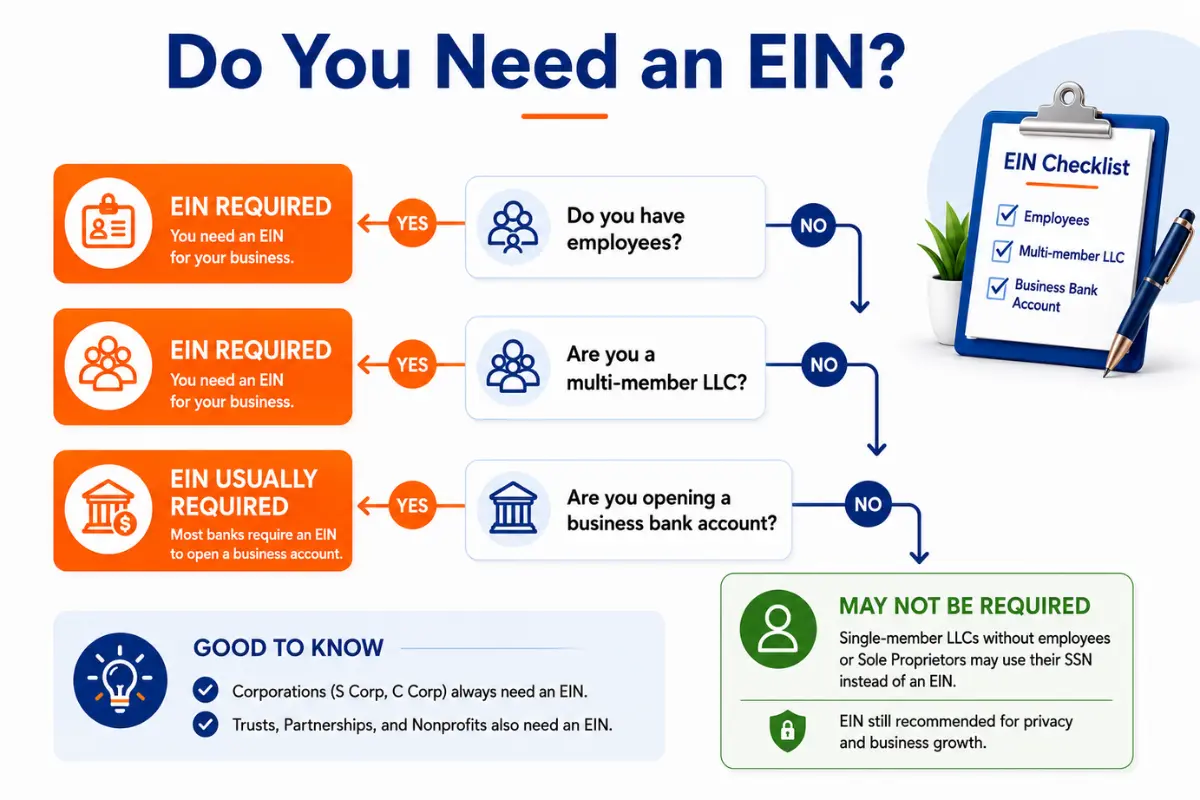
Here is where things get practical. If you are asking "do I need an EIN for a business bank account," the answer is: usually yes, especially for LLCs. Most banks require an EIN to verify your business and stay compliant with federal regulations. Even sole proprietors often get asked for one when opening a business account.
Separating your business and personal finances keeps your books cleaner, simplifies tax filing, and reinforces the liability protection your LLC provides. It also signals to clients and vendors that you are running a legitimate operation.
Even if you are not legally required to have one, getting an EIN is one of the smartest early moves you can make for your business. And having a professional handle it means it gets done right the first time.
An EIN replaces your Social Security Number on business paperwork, reducing identity theft risk. It is required to hire employees or run payroll legally. It anchors your business credit profile, keeping it separate from your personal finances. And it makes tax filing cleaner since all business income is tied to a dedicated business tax ID rather than your personal SSN.
The U.S. Small Business Administration notes that an EIN can help business owners separate personal and business finances while preparing for growth and hiring. That foundation matters at every stage of growth.
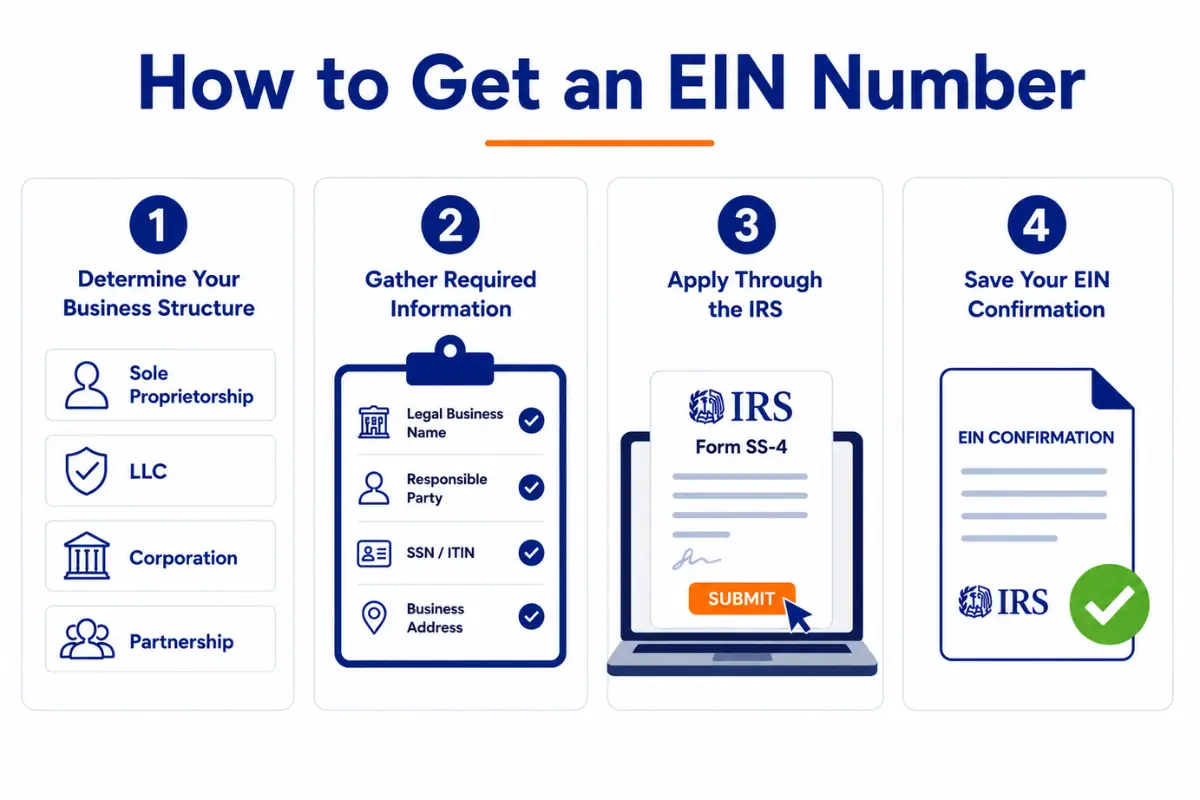
Here is how the EIN application process works, and where having professional guidance makes the biggest difference.
You will apply as the appropriate entity type, whether that is a sole proprietorship, LLC, corporation, or partnership. Getting your entity type right before you apply is critical.
Before you apply, have these handy: your legal business name, your name as the responsible party, your Social Security Number or ITIN, and your business address.
You apply using IRS Form SS-4, either online through the IRS website, by fax, or by mail. The IRS issues one EIN per day per responsible party. That is where MyLLC comes in. Rather than navigating the application on your own and risking a filing error, our team handles it for you, making sure everything is submitted correctly under the right entity type from day one.
The IRS sends an EIN confirmation letter once your application is processed. Save it. You will need it for your business bank account, tax filings, and payroll setup.
Applying for multiple EINs. Each business entity gets one. You only need a new EIN if you form a new legal entity.
Choosing the wrong entity type. Filing under the wrong structure creates tax and compliance problems. Our guide on how to choose a business structure can help you get clear before you apply.
Mixing personal and business finances. Getting an EIN is step one. Using it consistently for all business transactions is step two.
Waiting too long to get one. Many business owners put off getting an EIN until they need it for a bank account or client contract. Getting it in place early removes that roadblock before it slows you down.
| Category | EIN | SSN |
|---|---|---|
| What it is | Business tax ID | Personal tax ID |
| Issued by | IRS | Social Security Administration |
| Used for | Business tax filing and banking | Personal identification and taxes |
| Key benefit | Separates business from personal | Personal financial identification |
Whether you are forming an LLC or figuring out your EIN requirements as a sole proprietor, having the right support makes the process much simpler.
Our team at MyLLC helps entrepreneurs get their business structure and paperwork right from the start. From LLC formation and registered agent services to EIN filing and ongoing compliance support, we handle the details so you can focus on running your business. Contact us today to get started.
Businesses with employees, multi-member LLCs, corporations, and partnerships are all required to have an EIN. Sole proprietors with no employees may use an SSN instead, though many still get an EIN for practical reasons.
A single-member LLC with no employees and no S Corp election may technically operate without one for federal tax purposes. However, most banks require an EIN to open a business account, making it difficult to run a real business without one.
Not always by law, but usually in practice. If you hire employees, elect S Corp taxation, or need a business bank account, you will need one. Many single-member LLC owners get an EIN right away to keep things simple.
Yes, if you have no employees and are not filing excise taxes, the IRS allows you to use your SSN. That said, most sole proprietors still benefit from getting an EIN to protect their SSN on client paperwork.
You can apply directly through the IRS, though many business owners choose to use a professional service to make sure the application is filed correctly under the right entity type. Errors during the application process can cause delays, so getting it right from the start is worth it.
It depends on your structure. Multi-member LLCs and corporations need one regardless. Sole proprietors and single-member LLCs without employees may not be required to have one, though it is still often a smart move.
Some banks allow sole proprietors to open accounts with just an SSN, but most require an EIN for LLCs and corporations. To avoid roadblocks, it is best to get your EIN before you try to open a business account.
Yes. Your EIN is the federal tax identification number that anchors your business credit profile, keeping it separate from your personal finances. When you open a business bank account, apply for business loans, or work with financial institutions, having an EIN tied to your business entity is what helps you build a business credit score over time.
It depends on the change. Converting from a sole proprietorship to an LLC, or restructuring as an S corporation, generally requires a new EIN because you are creating a new business entity for federal tax purposes. Changing your business name or address does not. A professional can confirm whether your situation calls for a new EIN before you file anything.
Often yes. Many wholesale distributors require a federal tax ID number before they will work with you, and most banks require an EIN to open a business bank account, especially for limited liability companies and corporations. Even if you are a sole proprietor who is not legally required to have one, not having an EIN can close doors with vendors and financial institutions who use it to verify your business type.
The IRS assigns one unique nine-digit number per business entity, and having multiple EINs for the same business can create confusion in your tax filings. If you end up with duplicates, you will need to contact the IRS specialty tax line to deactivate the extras. Getting the application right the first time, under the correct legal name and responsible party, avoids this entirely.