

You’ve got a business idea, a side hustle, or a freelance gig that’s starting to gain traction. Things are going well, but there’s a nagging question in the back of your mind: “Should I make this official?” For many business owners, forming a Limited Liability Company (LLC) is the next step toward protecting their personal assets and building something legitimate. If you’re still weighing your options, understanding your business structure choices can help you decide whether an LLC is the right fit before moving forward.
Starting an LLC doesn't have to be intimidating. At MyLLC, we've helped countless business owners navigate the process from start to finish. Once you understand the steps involved, it becomes a lot less scary. This guide walks you through everything you need to know.
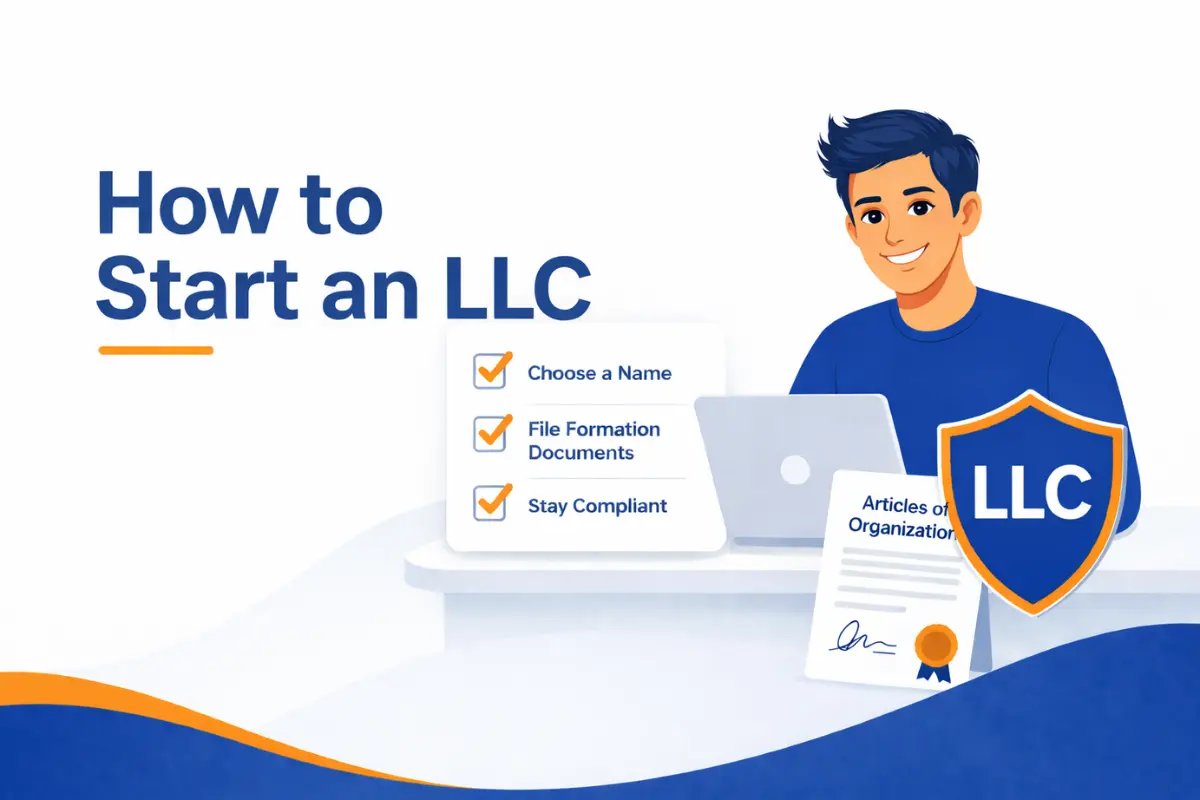
An LLC separates your personal assets from your business liabilities, giving you crucial protection.
Forming an LLC typically takes one to four weeks, depending on your state.
State filing fees range from $35 to $500, with additional costs for optional services.
Working with a professional formation service saves time, reduces errors, and ensures your LLC is set up correctly from day one.
Once your LLC is formed, ongoing compliance keeps it in good standing.
An LLC is a legal business structure that combines liability protection similar to a corporation with relatively simple operations and flexible, pass-through tax treatment. When you form an LLC, your business becomes a separate legal entity from you, the owner. Depending on your situation, you may form a single-member LLC or a multi-member LLC, each with different tax and management considerations.
That separation matters more than most new business owners realize. If someone sues your business or a creditor comes after it, they generally have to go after the LLC's assets, not your personal savings, home, or car, as long as you follow the rules and do not personally guarantee the debt or commit wrongdoing.
To form an LLC, you typically need a unique business name, a registered agent, and to file articles of organization (or a similar form) with your state, which is usually simpler than forming a corporation. That's the basic framework. Most LLCs also benefit from flexible tax treatment, which we'll cover later.
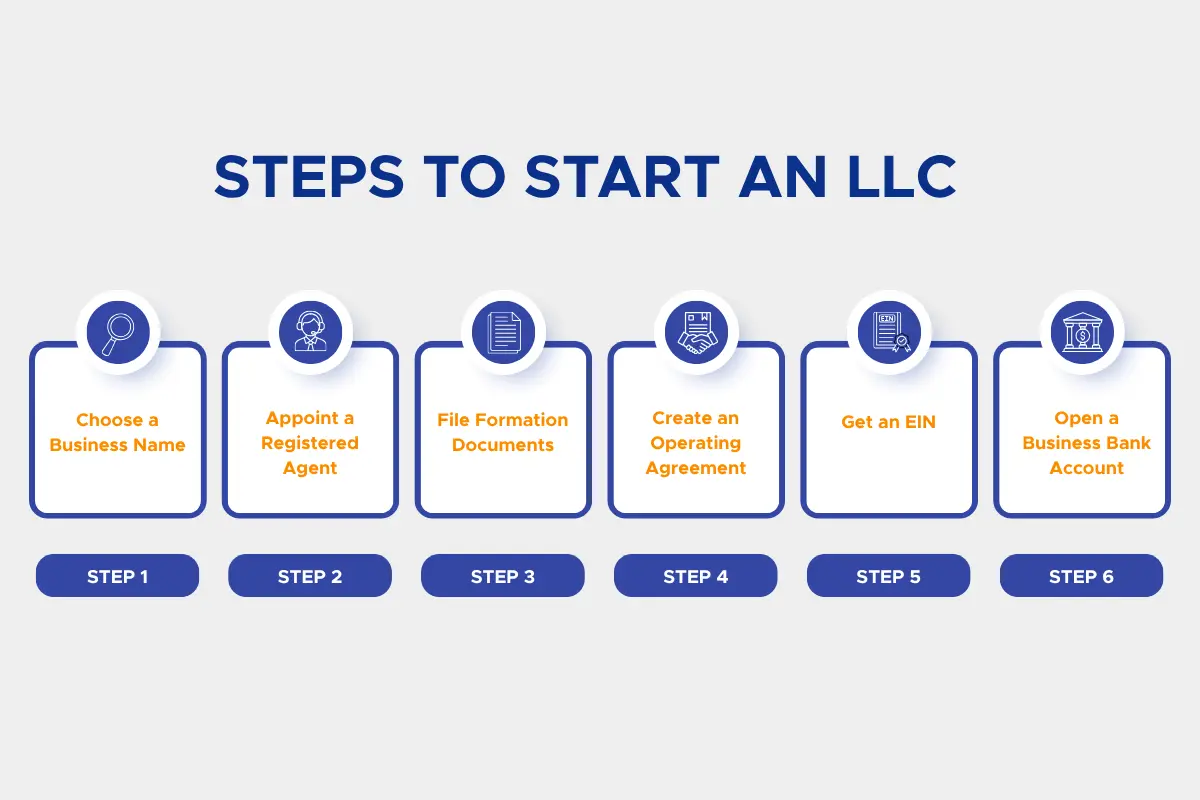
Here’s the core LLC formation process, broken down into six manageable steps.
Your LLC name needs to be unique in your state and include a designator like “LLC” or “Limited Liability Company.” Before you fall in love with a name, check your state’s business name database to confirm it’s available. Also run a quick trademark search and see if the domain name is taken so your branding stays consistent across the board.
Every LLC is required to have a registered agent. This is a person or company designated to receive legal notices, tax documents, and official correspondence on behalf of your business. You can serve as your own registered agent, but many business owners prefer to use a professional registered agent service for added privacy and reliability. Understanding what a registered agent does and why it matters can help you decide whether to handle it yourself or hire a pro.
Every LLC is required to have a registered agent. This is a person or company designated to receive legal notices, tax documents, and official correspondence on behalf of your business. You can serve as your own registered agent, but many business owners prefer to use a professional registered agent service for privacy and reliability. At MyLLC, we offer registered agent services to make this step simple.
This is the official step that creates your LLC. You’ll file Articles of Organization (sometimes called a Certificate of Organization) with your state’s business filing office. According to the U.S. Small Business Administration, this filing is required to officially register your business and legally operate it.
An operating agreement is an internal document that outlines how your LLC will be run. It covers ownership percentages, decision-making processes, profit distribution, and what happens if a member leaves. Not every state legally requires one, but having one in place helps protect you and avoid ambiguity down the road. Understanding whether your state requires an operating agreement and why it’s still a smart move even when it doesn’t can help you make the right decision early on.
An Employer Identification Number (EIN) is essentially a Social Security number for your business. The IRS uses it to identify your LLC for tax purposes. As the IRS explains, an EIN is used for filing business tax returns, opening bank accounts, and hiring employees.
Once you have your EIN and formation documents, open a dedicated business bank account. This step is critical for maintaining the legal separation between you and your LLC. Mixing personal and business finances can put your liability protection at risk.
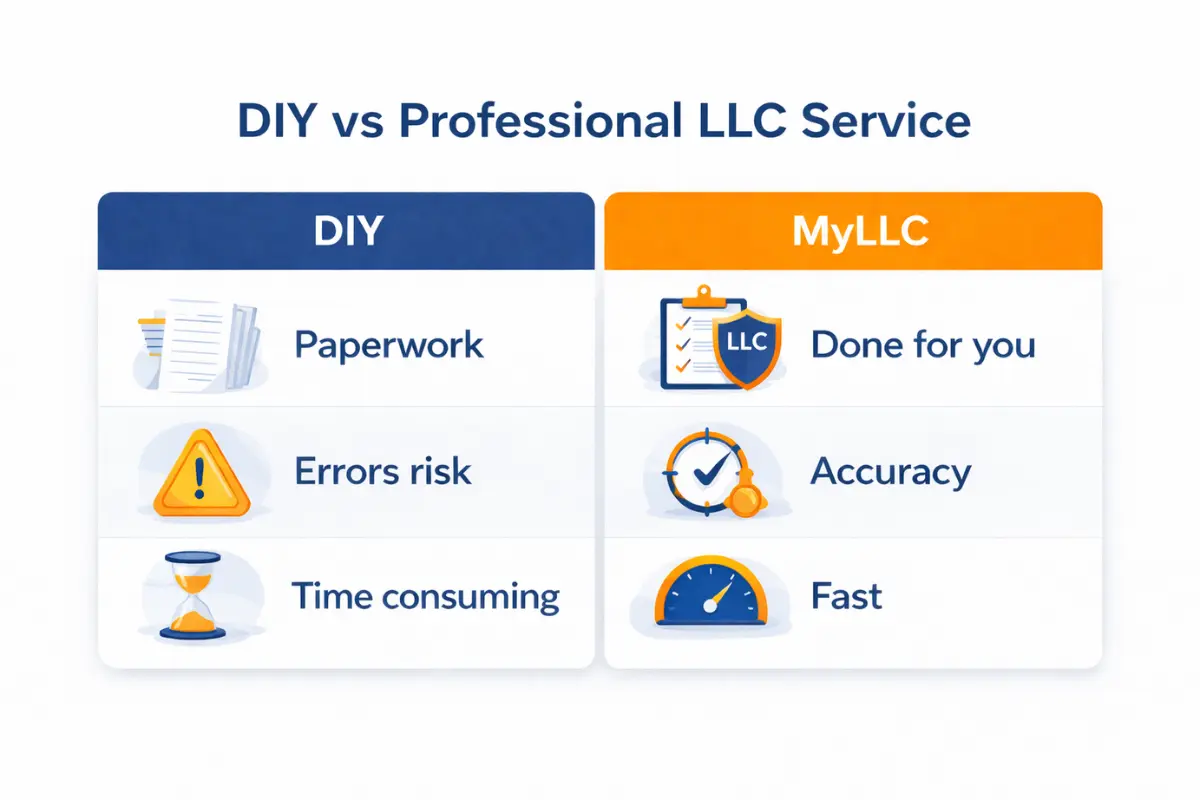
When it comes to forming your LLC, you have two options: filing on your own or working with a professional formation service. Both can get the job done, but they don’t deliver the same results.
Filing on your own means navigating your state’s website, researching requirements, and managing every piece of paperwork yourself. It’s possible, but state filing systems aren’t always intuitive, requirements vary widely, and a single error can result in rejected documents, delays, or gaps in your compliance that create problems later.
Working with a professional formation service like MyLLC means the filing is handled correctly from the start. We know the requirements, manage the paperwork, and keep you on track with ongoing compliance after your LLC is formed. For most business owners, that peace of mind is well worth it.
The upfront investment in a professional formation service is minimal compared to the cost of filing errors, rejected documents, or missed compliance deadlines. When the paperwork is done right the first time, you avoid delays and get your business up and running faster.
When you file your Articles of Organization, you’ll submit them to your state’s Secretary of State office along with the required filing fee. Some states allow online filing; others require paper submissions by mail. The form itself is usually straightforward, asking for basic information like your LLC name, registered agent details, and business address.
After filing, the state reviews your documents for completeness and compliance with state law. Most standard filings are approved without issue. If something is missing or there’s a name conflict, you’ll be notified and given a chance to correct it.
Once approved, you’ll receive a filed copy of your Articles of Organization and, in many states, a separate Certificate of Organization (or Certificate of Formation) as official proof that your LLC exists. Keep these documents somewhere safe, as you’ll need them to open a bank account, apply for licenses, and handle various business matters.
Forming an LLC isn’t a one‑and‑done event. Most states require LLCs to file annual or biennial reports and pay associated fees to remain in good standing, and many require periodic updates to your registered agent information. Missing these deadlines can result in late fees and, if left unresolved, administrative dissolution of your LLC.
The biggest variable in LLC formation costs is your state’s filing fee. These fees range from as low as $35 in Montana to $500 or more in states like Massachusetts, with Kentucky at $40. The national average sits around $132. This fee is due when you submit your Articles of Organization to the state. To learn more about what to expect, visit our guide to LLC costs.
If you use a professional registered agent service instead of serving as your own, expect to pay between $100 and $300 per year, though some basic plans start near $50. This is generally worth it for the privacy, compliance reminders, and reliability it provides.
You may also encounter optional costs like expedited filing fees, operating agreement templates, EIN filing assistance, and annual report filing services. These aren’t required, but they can save you significant time and reduce the risk of errors during formation.
Processing times vary by state, but most LLCs are approved within one to four weeks under standard filing, with online submissions often faster and mail filings often slower. Some states, like Delaware and Wyoming, are known for relatively quick turnaround times. Others, like New York, can take longer due to higher filing volumes and more extensive review, not because of its publication requirement, which happens after approval.
If you’re in a hurry, most states offer expedited processing for an additional fee. In many states, rush processing can get your LLC approved in as little as 24 to 48 hours, while others offer 2‑ to 5‑business‑day options. This is a good choice if you need to sign a contract, open a bank account, or close a deal quickly.
The U.S. Chamber of Commerce notes that an LLC is one of the most popular business structures for small business owners because it offers liability protection with relatively little administrative overhead compared to a corporation. If you’re earning business income, working with clients, or have personal assets worth protecting, an LLC is a smart move.
If you’re testing a brand‑new idea with minimal financial exposure and no clients yet, you might not need to form an LLC immediately. The U.S. Small Business Administration notes that sole proprietorships can be a good fit for low‑risk businesses and owners just starting out, so hobbyists and occasional freelancers sometimes begin this way before formalizing as an LLC. That said, even early‑stage businesses can benefit from the protection an LLC provides, as long as the added costs and compliance make sense for your situation.
LLCs are popular across industries. Freelancers, consultants, real estate investors, e-commerce sellers, contractors, content creators, and small retail operations all commonly use LLCs. If you’re generating revenue and want to operate your business properly, an LLC is one of the most flexible and accessible structures available.
One of the biggest reasons people choose LLCs is the tax flexibility. By default, an LLC is a pass‑through entity, meaning the business itself doesn’t pay federal income taxes. Profits and losses pass through to your personal tax return (Schedule C for a single‑member LLC or Form 1065/K‑1s for a multi‑member LLC). This avoids the “double taxation” that C‑Corporations face, where the business pays taxes on profits and shareholders also pay taxes on dividends.
As a single‑member LLC, you’ll pay self‑employment taxes on your net business income. That rate is 15.3% (12.4% for Social Security and 2.9% for Medicare) on the first $184,500 of net earnings in 2026, with Medicare tax continuing on earnings above that threshold. As a business owner, you’re responsible for the full amount, unlike traditional employees whose employers cover half.
Once your LLC is generating consistent profit, you may want to consider electing S-Corp tax status. This allows you to pay yourself a reasonable salary and take remaining profits as distributions, which are not subject to self-employment taxes. The savings can be significant. A business generating $150,000 in profit could save several thousand dollars annually with proper S-Corp structuring.
LLC requirements vary from state to state. Every state has its own filing fees, processing times, and ongoing compliance obligations. Some states, like Nevada and Wyoming, are considered business-friendly due to low fees and strong privacy protections. Others, like California, have additional taxes and publication requirements.
The most important thing is to understand the rules in the state where you form your LLC and where you primarily do business. If you operate in multiple states, you may also need to register as a foreign LLC in each additional state. We can help you navigate multi-state requirements and make sure nothing falls through the cracks.
Starting an LLC is one of the best decisions a small business owner can make. It protects your personal assets, gives your business credibility, and opens up tax planning options that can save you real money over time. The LLC formation process is straightforward when you take it one step at a time.
Whether you’re just getting started or finally ready to make your side hustle official, the most important thing is to take action. The longer you wait to form your LLC, the longer you’re operating without protection.
Starting an LLC can be simple, but missing steps can cause real headaches down the road. Errors in your filing, gaps in your operating agreement, or missed compliance deadlines can cost you time, money, and the protection you formed the LLC to get in the first place.
Our team guides you through the entire process, from name search and filing to ongoing compliance support. Contact us today to get your LLC formed quickly and correctly, so you can focus on building your business.
Technically, you can file directly through your state's Secretary of State website. However, state filing portals vary in complexity, and it's easy to overlook requirements or make errors that slow down your approval. Using a professional formation service like MyLLC is a faster and more reliable way to get it done right, without having to navigate the process alone.
Technically, yes. A single-member LLC is a valid structure, and you can file as the sole member with full ownership and control. That said, going it alone means you're responsible for getting every detail right, from the filing itself to ongoing compliance. Many solo business owners find that working with a formation service saves them time, reduces stress, and prevents the kinds of mistakes that are easy to make when you're doing it for the first time.
At minimum, you'll need a unique business name, a registered agent in your state, and completed Articles of Organization filed with the appropriate state office. Most people also obtain an EIN, create an operating agreement, and open a dedicated business bank account as part of the full setup process.
For most business owners, yes. The protection an LLC provides is worth more than the filing fee in virtually any situation where you have income, clients, or assets at stake. The peace of mind that comes from knowing your personal finances are separated from your business is something most entrepreneurs say they wish they'd had from day one.
An LLC operating agreement is an internal legal document that defines how your limited liability company will be owned and managed. It covers ownership percentages, profit distribution, member responsibilities, and what happens if someone leaves. For a single member LLC, it reinforces the separation between you and the business. For a multi member LLC, it helps prevent disputes before they start. Not every state requires one, but it's considered a best practice for any LLC.
The biggest difference is personal liability. A sole proprietorship has no formal business structure, meaning there is no legal separation between you and your business. Your personal assets are directly exposed to any business debts or lawsuits. An LLC is a recognized legal entity that creates a clear barrier between your personal and business assets. Both offer pass through taxation, but the LLC gives you significantly more protection and credibility as a business owner.
Yes, but the LLC itself does not pay federal income tax by default. For federal tax purposes, a single member LLC is treated as a disregarded entity and business income flows to your personal tax returns. A multi member LLC is taxed as a partnership. LLC owners also pay self employment tax on their share of profits. Depending on your state, you may owe franchise taxes or excise taxes as well. If your income grows, electing S Corp status can meaningfully reduce your self employment tax burden.