

You have a business idea, a side hustle bringing in real income, or a freelance career that's starting to gain traction. Now comes the question every solo entrepreneur eventually faces: how should you legally structure your business?
Many people at this stage start asking the same question: what is a single member LLC, and is it the right structure for my business?
A single member LLC is a business structure designed for one owner that provides limited liability protection while allowing pass-through taxation.
For many solo entrepreneurs, forming a single member limited liability company is the smart next step, combining personal liability protection with straightforward tax treatment.
At MyLLC, we help entrepreneurs form single member LLCs every day. Below, we’ll explain exactly how it works, how it’s taxed, and when it makes sense for your situation.
A single member LLC, often called an SMLLC, is a limited liability company with only one owner. That owner can be an individual, another LLC, or even a corporation.
It is a type of business structure that combines the simplicity of sole ownership with the legal protections of a registered limited liability company.
It’s a formal business entity registered with your state, but far simpler to operate than a corporation. No board of directors, no shareholder meetings, just you running the business with a legal structure working in the background to protect you. It’s a popular choice for freelancers, independent contractors, consultants, and real estate investors operating solo.
Yes, and this is one of the biggest reasons people form one. The U.S. Small Business Administration explains that an LLC is a business structure that protects its owners from personal responsibility for business debts and liabilities.
In practical terms: if your business gets sued or can't pay its debts, your personal bank account, home, and savings are generally protected. Without this protection, a sole proprietor's personal assets are fully exposed. Forming a single member LLC creates that legal wall between your business and your personal life.
This legal separation between you and your business is often referred to as the “corporate veil,” and maintaining that separation is essential to preserving your liability protection.
Single member LLC taxation is straightforward by default, but it offers flexibility depending on how you elect to be taxed. By default, the IRS treats an SMLLC as a "disregarded entity," meaning it doesn't file its own tax return.
The IRS explains that "a limited liability company (LLC) that has only one owner is treated as an entity disregarded as separate from its owner for income tax purposes." In plain terms: your business income flows directly onto your personal tax return. You get the liability protection of an LLC with the tax simplicity of a sole proprietorship.
Most SMLLCs report income and expenses on Schedule C, attached to a Form 1040. If the LLC owns rental property, Schedule E may apply. Even without employees, getting an EIN is smart because it helps you open a business bank account and keeps your finances properly separated.
Yes. Your net business income is subject to self-employment tax, currently 15.3% on the first $176,100 (as of 2025) and 2.9% above that. The good news is that there's a way to reduce this through an S-Corp election.
Yes, and for profitable LLCs, it’s one of the smartest tax moves available. By filing IRS Form 2553, your single member LLC can elect to be taxed as an S-Corporation instead of a disregarded entity. This changes how your income is treated for payroll tax purposes.
Under S-Corp taxation, you must pay yourself a reasonable salary as an employee of your business. That salary is subject to payroll taxes (Social Security and Medicare), just like any other employee. However, any additional profits can be distributed to you as shareholder distributions, which are not subject to self-employment tax.
For businesses netting $150,000 or more, the annual tax savings can be significant, sometimes thousands of dollars per year, depending on how compensation is structured.
However, S-Corp status does add complexity. You’ll need to run payroll, file quarterly payroll tax returns, maintain proper corporate records, and follow stricter IRS compliance rules. If the IRS determines your salary is unreasonably low, it can reclassify distributions and assess penalties.
Because of these additional requirements, S-Corp taxation makes the most sense once your profits consistently justify the added administrative work. A tax professional can help you evaluate whether the potential savings outweigh the compliance responsibilities.
As Forbes Advisor notes, a single-member LLC combines liability protection with pass-through taxation, making it a popular option for solo business owners. The advantages of a single member LLC include:
Personal liability protection separates your business debts from your personal assets
Pass-through taxation avoids the double taxation C-Corporations face
Flexible tax options: elect sole proprietor, S-Corp, or C-Corp treatment.
Simple management: you're in charge, no board meetings required
Enhanced credibility: "LLC" after your name signals a legitimate, professional business
Low formation costs compared to corporations
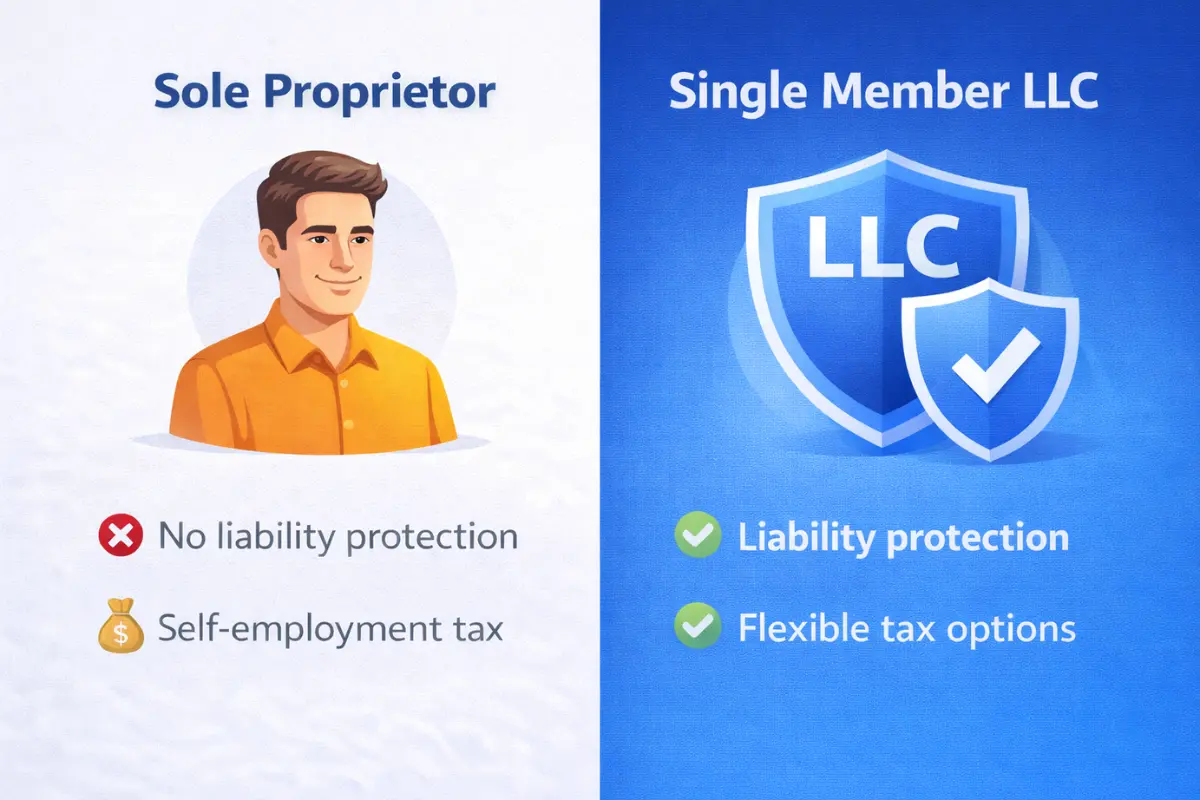
This is the most common comparison, and the answer usually favors the LLC. The core difference is liability. A sole proprietor has no separation between personal and business; if a client sues, everything you own is exposed. A single member LLC creates that separation by law, and the formation cost ($50–$500 in state filing fees) is minimal compared to the protection you gain.
| Feature | Single Member LLC | Sole Proprietorship |
|---|---|---|
| Liability | Limited — personal assets protected | Unlimited — personal assets at risk |
| Taxes | Pass-through taxation (default IRS “disregarded entity”) - reported on Schedule C | Pass-through taxation - reported on Schedule C |
| Formation | State filing required | No filing required |
| Credibility | Higher — formal business entity | Lower — no formal structure |
| S-Corp Election | Available | Not available |
Both offer the same liability protection. The differences come down to ownership and taxes. A single member limited liability company is taxed as a disregarded entity; a multi-member LLC files a partnership return (Form 1065). If you're solo, an SMLLC is the natural fit. If you're bringing on a partner, a multi-member LLC is worth exploring from the start.
| Feature | Single Member LLC | Multi Member LLC |
|---|---|---|
| Owners | One | Two or more |
| Tax Filing | Schedule C (disregarded entity) | Form 1065 partnership return |
| Operating Agreement | Recommended | Strongly recommended |
| Management | Sole owner decides | Shared or designated manager(s) |
A single member LLC makes sense if you:
Are the sole owner of a business
Want liability protection without corporate complexity
Are a freelancer, consultant, or independent contractor with regular income
Are converting from a sole proprietorship to formalize your business
Own rental property and want asset protection
If you anticipate adding partners or outside investors in the near future, forming a multi-member LLC or corporation from the outset may be more appropriate. For solo entrepreneurs, however, a single member LLC often provides the ideal balance of liability protection and operational simplicity.
Each state has its own single member LLC requirements, fees, and timelines. Most require filing Articles of Organization with the Secretary of State. Fees range from roughly $50 to over $400 depending on the state, and some states have ongoing annual report requirements or franchise taxes. It's worth checking your state's specific rules or letting us handle it for you.
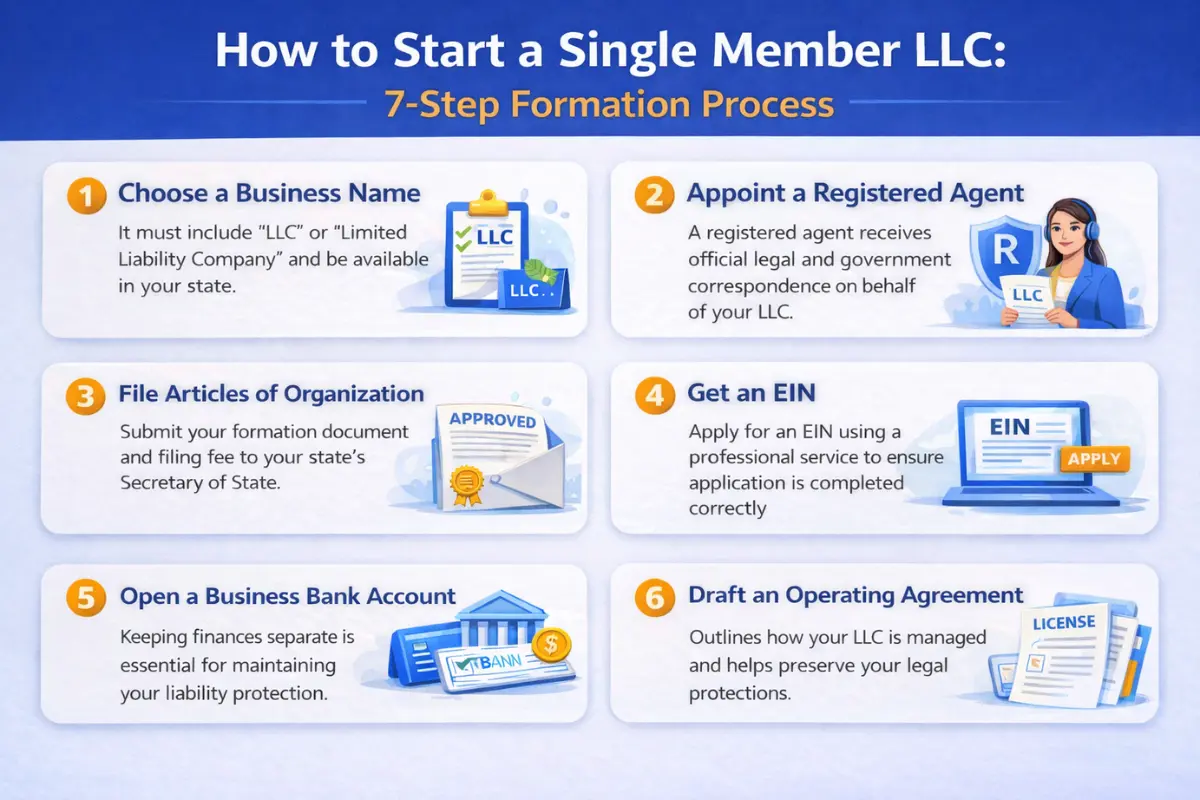
Choose a business name. It must include "LLC" or "Limited Liability Company" and be available in your state.
Appoint a registered agent. A registered agent receives official legal and government correspondence on behalf of your LLC.
File Articles of Organization. Submit your formation document and filing fee to your state's Secretary of State.
Get an EIN. While you can apply directly through the IRS online, many business owners choose to use a professional service to ensure the application is completed correctly and to avoid delays that can impact banking and tax setup.
Open a business bank account. Keeping finances separate is essential for maintaining your liability protection.
Draft an operating agreement. Outlines how your LLC is managed and helps preserve your legal protections.
Obtain necessary licenses and permits. Requirements vary by industry, state, and location.
Not every state requires one, but we strongly recommend it. A single member LLC operating agreement documents how your business is owned and managed. It reinforces the separation between you and your LLC, which protects your liability shield, and many banks require one when opening a business account.
Mixing personal and business finances. This can pierce your liability protection. Open a dedicated business account from day one.
Skipping the operating agreement. Even if not required, it protects your LLC status and provides important legal clarity.
Missing annual compliance deadlines. Most states require annual reports and fees to keep your LLC active. Missing them can lead to penalties or dissolution.
Not revisiting your tax classification. As income grows, the default disregarded entity status may no longer be optimal. An annual review with a tax professional can uncover real savings.
Forming a single member LLC doesn't have to be complicated. Our team handles everything, including Articles of Organization, registered agent setup, and ongoing compliance support, so you can stay focused on building your business.
Ready to protect your business and get started the right way? Contact us today to form your single member LLC.
For solo business owners, a single member limited liability company delivers a powerful combination: personal asset protection, tax simplicity, and real credibility, without the complexity of a corporation.
Whether you're a freelancer, a side hustler, or a small business owner ready to go legit, the single member LLC is often the smartest first step. The process is simpler than most people expect, and the peace of mind is well worth it.
Yes. Single member refers to ownership, not staffing. You can hire employees, you'll just need an EIN and to comply with employer tax obligations.
You don't legally have to in most states, but you absolutely should. Commingling funds is one of the fastest ways to lose your liability protection.
Yes, it's a very common move. File Articles of Organization, get a new EIN, and update your business accounts and contracts to reflect the LLC.
The IRS treats it as a disregarded entity, meaning income passes through to your personal return via Schedule C.
Yes, limited liability protection is one of the most significant advantages of forming a single member LLC. As a separate legal entity, the LLC is responsible for its own debts and obligations. That means your personal assets, such as your home, savings, and personal bank accounts, are generally shielded from business liabilities. You could be held personally liable in certain cases, such as if you personally guarantee a loan or commingle personal and business funds, so maintaining a clear separation between personal and business finances is essential.
For federal income tax purposes, a single member LLC is treated as a disregarded entity by the Internal Revenue Service. This means the LLC does not file a separate federal income tax return. Instead, the owner reports all business income and expenses directly on their personal tax return, typically on Schedule C. The LLC's profits and losses flow straight through to the sole member, making pass-through taxation one of the structure's most practical benefits.
It depends on the type of business. While most single member LLCs are not subject to excise taxes, certain industries, such as fuel, tobacco, alcohol, firearms, and heavy vehicles, may carry excise tax liability. If your business falls into one of these categories, you may be required to file excise tax returns with the IRS, separate from your personal income tax return. If you're unsure whether your business activity triggers certain excise taxes, a tax professional can help you determine your obligations.
A single member LLC can raise money by bringing in new members or securing business loans, but it cannot sell stock the way a C corporation can. If raising capital through equity investors or issuing shares is a priority, especially for venture-backed startups, converting to a corporation may make more sense down the road. That said, for most small businesses and solo operators, the single member LLC provides more than enough flexibility for growth without the complexity of a corporate structure.
Unlike a sole proprietorship, a single member LLC is a separate legal entity that can continue operating after ownership changes. Transferring ownership of a single member LLC is possible, either by selling your membership interest or assigning it to another party. However, some states impose restrictions on transfers, and your operating agreement should address how this process works. In community property states, a spouse may have an ownership interest in the LLC as well, which can affect transferring ownership. Having a well-drafted operating agreement in place makes these transitions far smoother.