

You put in the work to form your LLC. You filed the paperwork, got your EIN, and opened a business bank account. But without a solid LLC operating agreement in place, your business could still be on shaky ground.
Many LLC owners skip this step entirely, thinking it is optional or only needed for larger companies. That assumption can lead to real problems, from co-owner disputes to courts falling back on state default rules instead of your actual intentions.
An operating agreement is the internal rulebook for your LLC. It defines how your business runs, who owns what, and what happens when things get complicated. MyLLC helps business owners get this right from the start, so there are no surprises later.
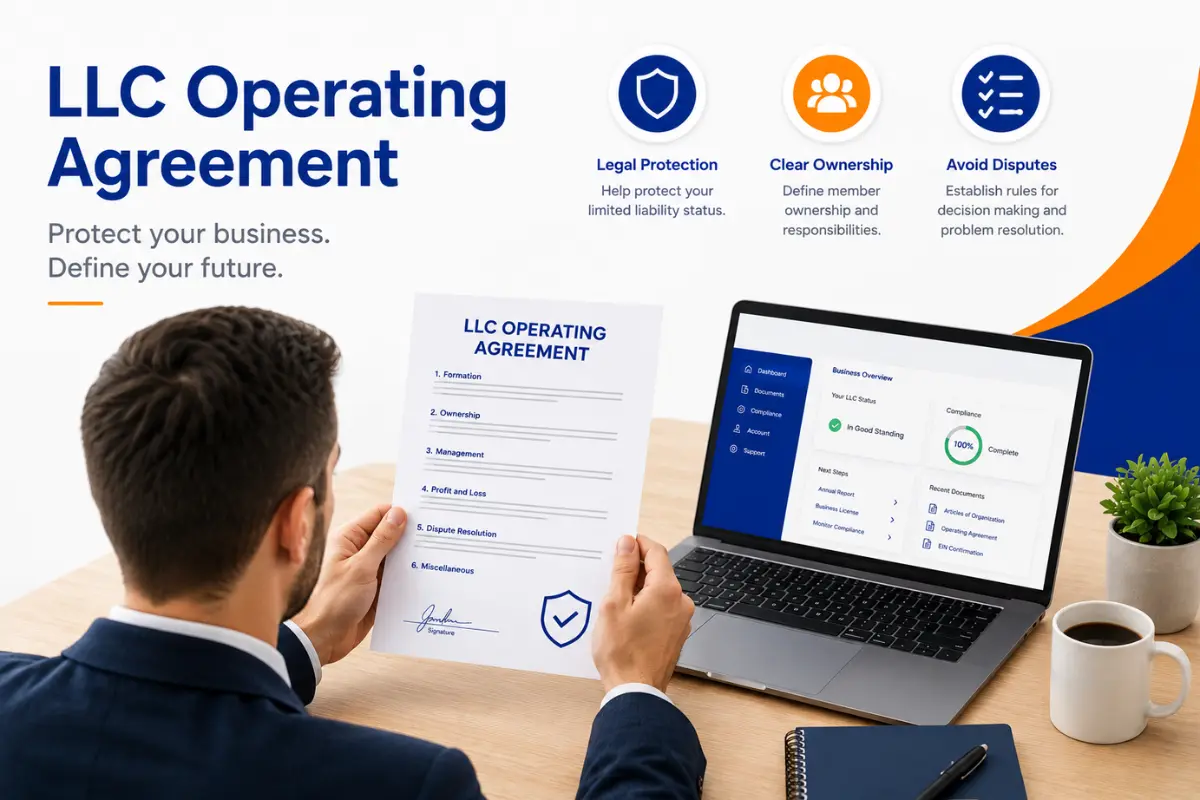
An LLC operating agreement defines ownership, roles, and how the business makes decisions.
Both single-member and multi-member LLCs should have one, even if your state does not require it.
Some states do legally require operating agreements, but every LLC benefits from having one regardless.
Without an agreement, courts may rely on your state's default rules, which may not reflect your intentions.
Templates can be a helpful starting point, but customization is what makes them actually useful.
An LLC operating agreement is a legal contract among the owners (members) of a limited liability company that sets out how the business is owned, managed, and operated. It explains who owns what, how decisions are made, and how profits, losses, and responsibilities are shared.
According to the U.S. Small Business Administration (SBA), an operating agreement outlines the financial and functional decisions of an LLC, including rules, regulations, and provisions.
Unlike your Articles of Organization, which are filed with your state to officially form your LLC and become part of the public record, an operating agreement is generally kept as an internal document and is not filed with the state.
Banks and other financial institutions may ask to review the operating agreement when you open a business bank account or apply for financing, and potential investors often request it to confirm ownership and decision‑making authority. If a dispute arises among the members, courts typically treat the operating agreement as the primary document that explains how the LLC is supposed to be governed and how important decisions should be made.
The short answer: yes, even if your state does not technically require one.
A handful of states, including California, New York, Missouri, Maine, and Delaware, do legally require LLCs to have an operating agreement. But even where it is not mandated, operating without one puts your business at a disadvantage.
Every state has default rules that apply to LLCs without their own agreement. Those rules were written for a general audience, not your specific business. If a dispute arises and you have no agreement to point to, a court applies those state defaults, which may not align with what you actually intended.
The IRS notes that LLCs are created under state law and can have different ownership and management structures, which means internal agreements (like an operating agreement) play a major role in defining how the business will function.
For single-member LLCs, an operating agreement is still important because it helps document the separation between you and your business and supports your limited liability status.
If you are still in the process of forming your business and have not created an operating agreement yet, our guide on how to start an LLC walks you through the key steps and shows you where the operating agreement fits into the overall formation process.
Every LLC is different, so your operating agreement should reflect the specific needs of your business. That said, there are several key areas that every solid agreement covers.
This section spells out exactly what percentage of the LLC each member owns. For single-member LLCs, this is straightforward. For multi-member LLCs, it prevents disputes by making ownership crystal clear from day one.
Who does what? This section defines each member's role within the business. It eliminates confusion and sets expectations early, especially important in partnerships where roles can blur over time.
How are decisions made? Do members vote based on ownership percentage, or does each member get one vote regardless of their stake? This section answers those questions and helps prevent deadlocks.
This outlines how profits and losses are allocated among members. It may mirror ownership percentages, or it may follow a different arrangement the members have agreed to.
Your LLC can be member-managed, where all members participate in running the business, or manager-managed, where one or more designated managers handle operations. This section documents that structure so everyone is on the same page.
People and circumstances change. Your agreement should outline the process for bringing in a new member or what happens when someone wants to exit the LLC. Without this, buyouts and transitions can get messy.
What happens if the business needs to shut down? This section covers how assets are distributed and liabilities are handled if the LLC dissolves. It is not a fun topic, but having the plan in writing protects everyone involved.
Not all operating agreements are built the same. The complexity of your agreement largely depends on how many members your LLC has.
A single-member LLC operating agreement is simpler in structure since there is only one owner. But do not let that simplicity make you think it is not worth having. Learn more about how single-member LLCs work and what sets them apart.
One key function of this agreement is to document a clear separation between you and your business, which supports your liability protection. Banks also frequently require it when opening a business account, even for solo operations.
When more than one person is involved, the operating agreement becomes significantly more important. A multi-member LLC operating agreement needs to clearly define who has authority to make decisions, how profits are divided, and what happens when a member wants out.
Leaving these details unwritten is a common reason business partnerships and multi‑owner LLCs fall apart. Disagreements over money, responsibilities, or authority are much easier to navigate when there is a signed document outlining how things work.
Here is a quick comparison of what each type of agreement typically addresses:
| Feature | Single Member LLC | Multi-Member LLC |
|---|---|---|
Number of owners |
1 |
2 or more |
Agreement complexity |
Simpler, owner-focused |
More detailed, member-focused |
Voting rules needed? |
Not usually |
Yes, important to define |
Profit sharing rules |
Owner takes all |
Must define percentages |
Dispute resolution |
Less critical |
Highly recommended |
Banking & liability use |
Establishes separation |
Defines each member's stake |
Exit/buyout provisions |
Optional |
Essential |
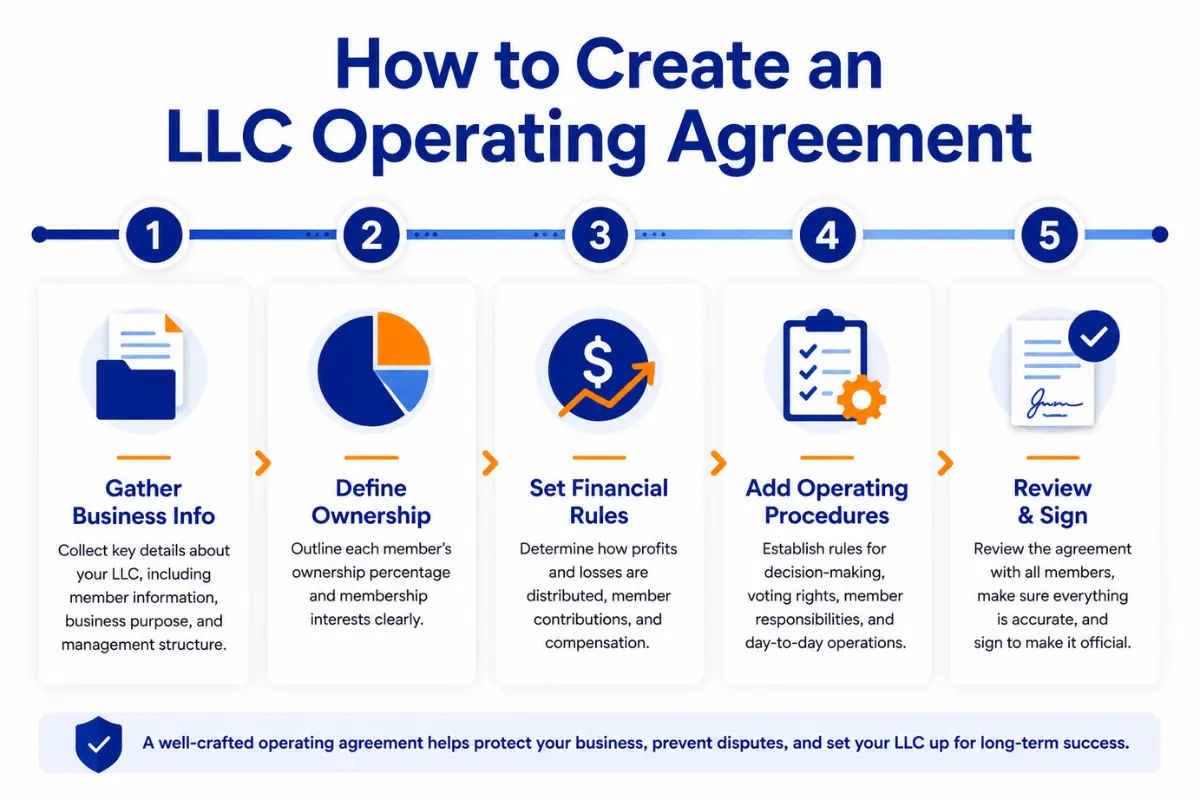
Creating an operating agreement does not have to be overwhelming. If you want a more detailed overview of whether your LLC requires one, visit our resource on do I need an LLC operating agreement. Here is a straightforward process to follow:
Start with the basics. You will need your LLC's legal name, the state where it was formed, the date of formation, and the contact information for each member.
Decide and document each member's ownership percentage and clarify whether the LLC will be member-managed or manager-managed. This sets the foundation for everything else.
Specify how much each member is contributing to the business initially, how profits and losses will be distributed, and how the LLC is taxed. If members will be paid salaries or receive guaranteed payments, document that here too.
This covers the day-to-day and big-picture stuff. How often will members meet? What decisions require a vote? How are records maintained? Getting this in writing keeps the business running smoothly, even as it grows.
Every member should review the document carefully before signing. Once it is signed, store it with your other important business records. It is also a good idea to revisit it whenever something significant changes in your business.
An LLC operating agreement template can be a useful starting point, especially if you are early in the formation process and want to understand what a typical agreement looks like. Templates give you a structure to follow and help ensure you cover the essential sections.
That said, templates have real limitations. A generic document found online was not written with your business in mind. It may not account for your state's specific laws, your industry's requirements, or the particular arrangement you have with your co-owners.
A typical LLC operating agreement example would include sections like: the LLC's name and state of formation, member names and ownership percentages, capital contributions, profit and loss allocation, management structure, voting procedures, and dissolution terms. Think of it as an outline that you then fill in with your specific details.
Free templates are widely available and can work for very basic situations, particularly for single-member LLCs with straightforward structures. Paid templates often include more detailed provisions and may come with guidance on how to customize them.
The real risk with either option is using them as-is without tailoring them to your situation. The document needs to accurately reflect your actual business structure, or it can create confusion rather than clarity.
Even business owners who do create an operating agreement often make avoidable mistakes. Here are the most common ones:
Using a generic template without customizing it for your specific business and state.
Not updating the agreement after adding or removing members.
Leaving out dispute resolution terms, which means you have no agreed-upon process when conflict arises.
Failing to clearly define voting rights, which can paralyze decision-making.
Not having all members sign the agreement, which can undermine its enforceability.
Your operating agreement is not a set-it-and-forget-it document. Life changes, and so does your business. Here are the key moments when an update is warranted:
Adding or removing members from the LLC
Changing ownership percentages among existing members
Making a new tax election, such as electing S-Corp status
Restructuring how the business is managed
Significant operational shifts, such as entering a new industry or changing your business model
Keeping your agreement current protects everyone involved and ensures the document continues to reflect how your business actually operates.
Technically, yes. There is no law that says you must hire an attorney to draft your operating agreement. For a simple single-member LLC with a straightforward structure, a well-chosen template that you customize carefully may be sufficient.
But the more complex your situation, the more value professional guidance provides. If you have multiple members, outside investors, or unique profit-sharing arrangements, having someone review your agreement can save you from costly mistakes later. Getting it right upfront is almost always less expensive than dealing with disputes after the fact.
An LLC operating agreement is not just a formality. It is one of the most practical documents your business can have. It protects your personal assets, prevents disputes, clarifies expectations, and tells the outside world that your LLC is a legitimate, properly run operation.
Whether you are a solo entrepreneur or building something with partners, having a solid agreement in place is smart business. The sooner you get it done, the more protected you are.
Our downloadable operating agreement template give you a professionally structured starting point that you can customize to fit your business. If you need help with formation or compliance, contact us today so we can help you build a business that is set up to last.
It depends on your state. A few states, including California, New York, Missouri, Maine, and Delaware, legally require LLCs to have one. But even where it is not required, having an operating agreement is strongly recommended. Without it, your state's default rules govern your LLC, and those may not match what you actually want.
Yes. Even as the only owner, an operating agreement establishes the legal separation between you and your business. This is key to maintaining your personal liability protection and makes it much easier to open a business bank account.
You can. For a straightforward single-member LLC, a carefully customized template can work well. For more complex arrangements with multiple members or investors, professional guidance helps ensure the document holds up when it matters.
Your LLC is governed by your state's default rules, which were written for a general audience and may not reflect your intentions. For multi-member LLCs, this can create serious conflict over decision-making, profit sharing, and what happens when a member leaves.
Store it with your important business records, in a secure digital folder or physical file. You do not file it with the state in most cases, but be ready to share it with your bank, investors, or attorneys when needed.
Yes. Your operating agreement can be amended as your business evolves. Most agreements include a process for making changes, which typically requires approval from all members. Always document changes formally and have members sign the updated agreement.
In most states, no. It is an internal document you keep on file. Unlike your Articles of Organization, it is not submitted publicly. A few states require you to maintain one on record, but filing it publicly is rarely required.
Many do. When opening a business bank account, banks often ask for your operating agreement alongside your Articles of Organization and EIN to confirm ownership and who is authorized to act on behalf of the LLC. Having it ready makes the process much smoother.