

Bringing on a new member is one of the biggest moves you can make as an LLC owner. It can mean more capital, shared responsibility, and serious growth potential. It can also mean tax headaches, legal gaps, and ownership disputes if it is handled incorrectly.
If you are planning to add a member to your LLC, it is important to do it the right way from the start. Most business owners get the handshake right. It is the paperwork where things fall apart.
At MyLLC, we help business owners handle ownership changes the right way so nothing gets overlooked. This guide walks you through exactly how to add a member to an LLC, including how to add a member to an existing LLC and handle the process correctly.

You can add a member to an LLC at any time
Adding a member changes your LLC from single-member to multi-member
Legal documents, including your operating agreement, must be updated
Tax classification typically shifts to partnership taxation
Skipping any step can lead to serious compliance and tax issues
The short answer is yes. LLCs are built for flexibility, which is one of the reasons so many business owners choose this structure. Whether your LLC is brand new or has been operating for years, knowing how to add a member to an LLC correctly is one of the most important things you can do for your business.
As the U.S. Small Business Administration explains, LLC owners are called members, and an LLC may have one or more members.
Business owners add members for many reasons: bringing in a partner to share the workload, attracting an investor, or formalizing a co-founder relationship. Whatever the reason, doing it right is what counts.
If you are still weighing whether an LLC is the right structure for your situation, our guide on how to choose a business structure can help you think it through.
When a new member joins your LLC, several things change. Ownership is no longer yours alone, so profit distributions, decision-making, and responsibilities all need to be clearly defined. Your operating agreement will need to be updated to reflect the new ownership structure, including each member's percentage stake, capital contributions, and role.
Tax classification is another major shift. A single-member LLC is treated as a sole proprietorship for federal tax purposes by default. Once you add a member to an existing LLC, the business is typically treated as a partnership, bringing new reporting requirements and a different tax filing process.
To better understand how ownership changes affect your business, review our multi-member LLC guide. You can also learn more about your current structure in our guide on what is a single-member LLC.
Before you add a member, it helps to understand exactly how a single-member and multi-member LLC differ. The table below breaks down the key distinctions.
| Feature | Single-Member LLC | Multi-Member LLC |
|---|---|---|
| Number of owners | One | Two or more |
| Default tax treatment | Disregarded entity (Schedule C) | Partnership (Form 1065) |
| EIN required | Optional (can use SSN) | Required |
| Operating agreement | Recommended | Essential |
| Management structure | Member managed | Defined by operating agreement |
| Self-employment taxes | Yes, on all profits | Yes, on each member's share |
Understanding these differences upfront helps you prepare for the legal, tax, and administrative changes that come with adding a new member to your LLC.
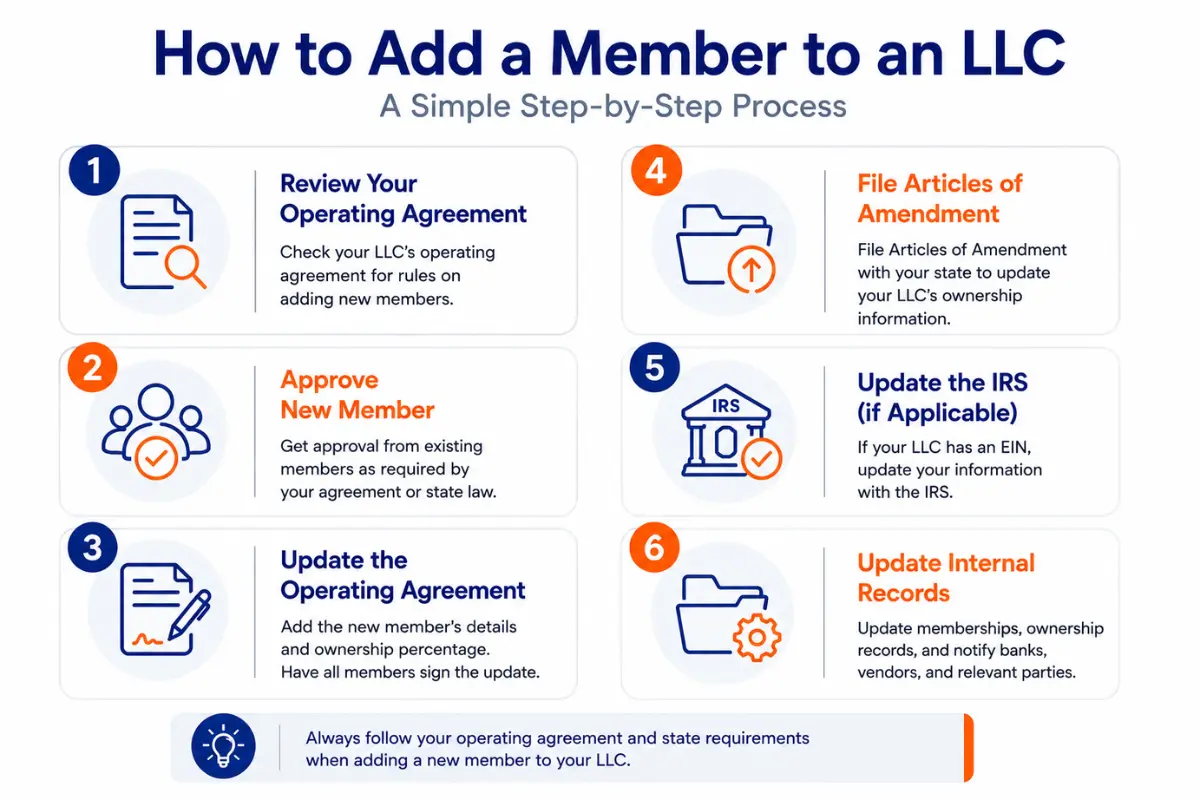
Your operating agreement is the rulebook for your LLC. Before anything else, read through it carefully. Some agreements include specific provisions about how new members can be admitted, what approvals are needed, or whether existing members have a right of first refusal. If you do not have one yet, now is the time to create it.
Learn why this document matters in our guide on whether you need an LLC operating agreement.
Even in a single-member LLC, adding someone new requires a formal approval process. Document the decision in writing, through a member resolution or consent form, to prove the new member was admitted through a proper process and not just an informal agreement.
This is one of the most important steps. Your updated operating agreement should clearly state each member's ownership percentage, roles and responsibilities, how profits and losses will be distributed, and how decisions will be made. Ambiguity here is where disputes begin, so be specific.
Not every state requires you to update your Articles of Organization when membership changes. Some states only require an amendment if member information is part of the original filing. Check your state's requirements, because missing a required filing can put your LLC's good standing at risk.
This step can be a common point of confusion for LLC owners. According to the IRS, a single-member LLC that adds members and transitions to a multi-member LLC will generally be required to obtain a new EIN. This process involves applying for a new Employer Identification Number and updating the entity’s tax classification with the IRS.
Once the legal groundwork is done, sweep through your business records. Update your bank accounts to reflect the new ownership, review existing contracts, and confirm your business licenses are still current. Some licenses may need to be reissued under the updated entity information.
Informal agreements are a liability. You might trust the person completely, but business relationships can change. Without documentation, you have no legal protection if things go sideways. Every agreement about ownership, roles, and profit sharing needs to be in writing and signed by all members. That is the foundation of how to add a member to an existing LLC the right way.
This is also where working with a professional service like MyLLC can make a real difference. A mistake in your documents or filings can cost far more to fix than to prevent. Whether you are starting an LLC fresh with multiple members or adding someone to an existing one, MyLLC helps ensure the process is handled accurately and with the seriousness it deserves.
Not all members are equal in terms of authority. A standard member owns a portion of the LLC but may not have day-to-day management responsibilities. A managing member has the formal authority to make decisions and act on behalf of the company.
If you are adding someone in a management role, your operating agreement needs to explicitly define their authority. This includes what decisions they can make independently, what requires a vote, and any limits on their scope. Vagueness here is a recipe for conflict.
Understanding adding a member to LLC taxes is one of the most important parts of this process and should not be overlooked. When your LLC goes from one member to two or more, it loses its default status as a disregarded entity and becomes classified as a partnership for federal tax purposes.
According to the IRS, a limited liability company with more than one member is classified as a partnership for federal income tax purposes. This means the LLC files a partnership return (Form 1065), and each member receives a Schedule K-1 to report their share of income, deductions, and credits on their personal return.
Members in a multi-member LLC are also generally subject to self-employment taxes on their share of profits. A CPA or tax professional can give you personalized guidance based on your situation.
It depends on your state. Some states require you to amend your Articles of Organization whenever membership information changes. Others treat membership changes as internal matters that only need to be reflected in your operating agreement.
The distinction matters because Articles of Organization are public records. If your state requires member information in that document, you will need to file a formal amendment and pay the associated fee. Skipping it when required can affect your LLC's standing with the state.
To get a sense of what formation and filing costs look like in your state, our page on the cost of an LLC is a helpful starting point.
Not updating the operating agreement before or right after the new member joins
Ignoring the tax implications, especially the shift to partnership taxation
Relying on a verbal agreement instead of documented, signed paperwork
Failing to check whether your state requires an amendment to your Articles of Organization
Forgetting to apply for a new EIN when required by the IRS
The timing is usually driven by a specific need. Maybe a partner has been contributing and you are ready to formalize the relationship. Perhaps you are bringing in an investor for capital. Or you are growing and need to share management responsibilities.
Whatever the reason, add a member before that person starts acting as one. Once someone is participating in profits or decisions without formal membership, you are in murky legal territory. Get the paperwork in place first.
Technically, you can handle this process yourself. State forms are available, the IRS has instructions, and operating agreement templates exist online. But doing it yourself means accepting full responsibility for every detail, including the ones that are easy to miss.
One wrong entry on a state amendment, an outdated EIN, or a gap in your operating agreement can create problems that take significant time and money to untangle. Professional services like MyLLC give you accuracy, peace of mind, and a team that has handled these filings before.
The question is not whether you can do it yourself. It’s whether assuming the risk is the right move when professional guidance can help you avoid costly mistakes.
LLCs are flexible by design, and that includes the ability to grow your ownership structure as your business evolves. Adding a member is significant, but manageable when you approach it with the right process.
Update your documents, handle your filings, and make sure your tax information reflects the new structure. Cutting corners creates problems that compound over time.
Take the time to do this right, and you set your new partnership up with the legal and financial stability it needs to succeed.
Bring on partners the right way. Our team handles your documents, filings, and compliance requirements so nothing gets overlooked. Whether you are adding an investor, a co-founder, or a business partner, we make sure every step is done correctly.
Contact us today to get started!
Start by reviewing your operating agreement for any rules on admitting new members. Then get formal written approval, update the operating agreement with the new member's ownership percentage and role, check whether your state requires an amendment to your Articles of Organization, and update your EIN and tax classification with the IRS if needed.
Yes. LLCs are designed to be flexible, and there is no restriction on when you can add a member. However, the process must be handled correctly to avoid compliance issues and unintended tax consequences.
In most cases, yes. When a single-member LLC adds a member and becomes a multi-member LLC, the IRS generally requires a new Employer Identification Number. Check the IRS guidelines or consult a tax professional to confirm the requirement for your specific situation.
The timeline varies depending on your state and whether amendments need to be filed. Updating your operating agreement and internal records can happen quickly, but state filings can take anywhere from a few days to several weeks.
Yes, and this is one of the most important tax consequences to understand before making any ownership change. A single-member LLC is treated as a disregarded entity by default, meaning the IRS does not recognize it as separate from the owner for tax purposes. Income is reported on a Schedule C using the owner's social security number or federal tax identification number. Once you add a member and convert to a multi-member LLC, that tax treatment changes entirely. The IRS now classifies it as a partnership, which requires filing a separate partnership return. If you want to elect corporate status instead, that is a separate decision that should be discussed with a tax accountant. Updating IRS records promptly ensures tax compliance and avoids issues down the road.
In most cases, yes. The specific process depends on your operating agreement and your state's limited liability laws, but adding a new member typically requires current members to formally approve the membership change. A well-drafted operating agreement will outline the voting rights of existing members and the formal procedures required to admit additional members. If your LLC does not have an operating agreement, or if it does not address member addition, default state laws will govern the entire process. To avoid future disputes, document the current members' vote in writing and update your official documents before the new owner begins participating in the business.
When you add a member to your LLC, the ownership structure must be recalculated. Each member's ownership interest needs to be clearly defined, typically based on their capital contribution relative to the fair market value of the company. In some cases, ownership percentages are negotiated based on the new member's role or what they bring to the business. Whatever formula you use, the updated ownership percentages must be reflected in an updated operating agreement. Leaving ownership interest vague between current members and new partners is one of the most common causes of future disputes.