

Not all business structures are created equal. The LLC vs corporation decision is one of the biggest calls you will make as a business owner, and most people get it wrong simply because nobody ever explained the difference clearly.
The structure you choose determines how much you pay in taxes, how protected your personal assets are, and how easily you can grow. That is not a small thing.
At MyLLC, we assist entrepreneurs in navigating the complexities of starting a business with clarity and confidence. Below is the straightforward guidance you’ve been seeking.
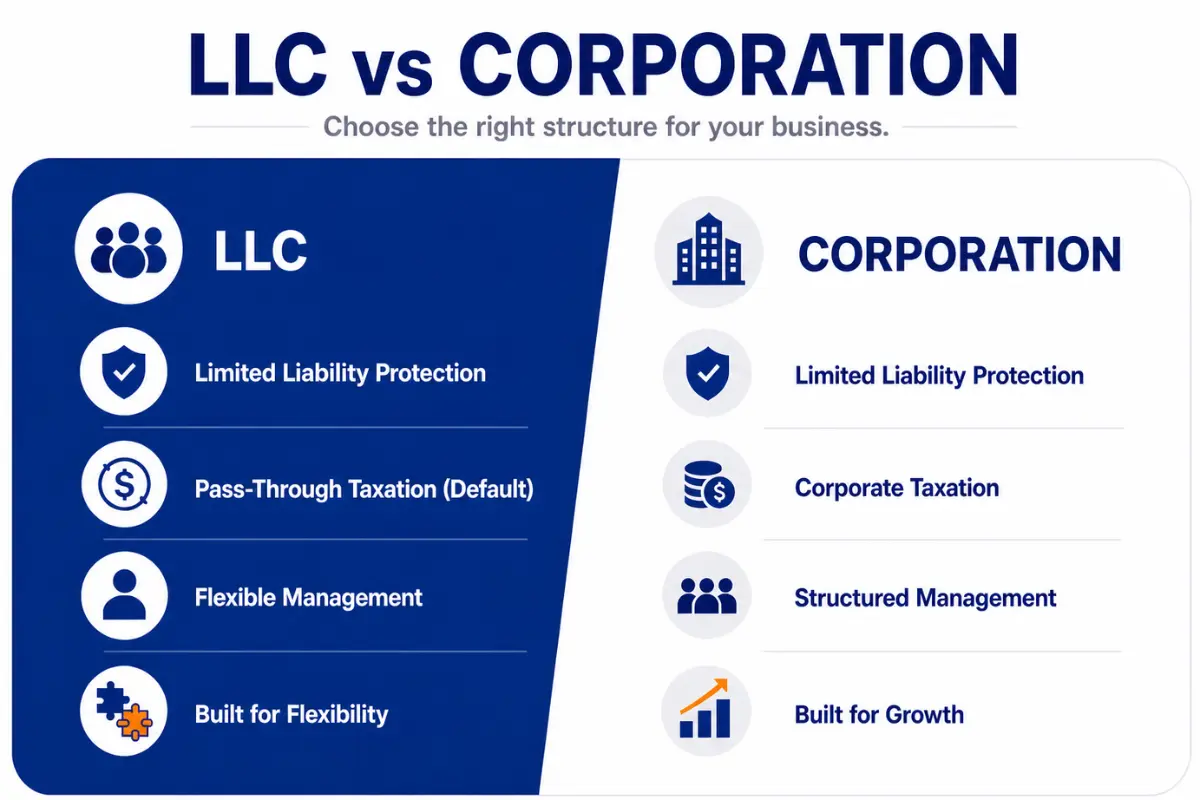
LLCs offer flexibility and pass-through taxation, making them ideal for most small businesses.
Corporations provide a stronger structure for growth and outside investors.
Taxes differ significantly between LLCs, S corps, and C corps, and the wrong choice can cost you thousands.
The best choice depends on your specific business goals, income level, and plans for the future.
An LLC, or limited liability company, is one of the most popular business structures in the United States, and for good reason. It is simple to set up, easy to manage, and gives you real legal protection.
According to the U.S. Small Business Administration, "a limited liability company (LLC) is a business structure in the U.S. that protects its owners from personal responsibility for its debts or liabilities."
That protection is the biggest draw. If your business gets sued or racks up debt, in most cases your personal savings, car, and home stay out of reach, as long as you maintain proper formalities and don’t personally guarantee debts. The business is its own legal entity, separate from you.
LLCs are owned by one or more "members," which is just the term for LLC owners. There are no shareholders or boards of directors required. You can run your LLC yourself or bring in a manager. The structure is flexible enough to work for a solo freelancer or a growing team.
On the tax side, LLCs are also appealing. By default, the IRS treats the income as passing straight through to your personal tax return. You avoid the "double taxation" that comes with certain corporations. And if your situation changes down the road, you can even elect to have your LLC taxed as an S corp or C corp without changing your underlying structure.
According to the IRS, “For federal income tax purposes, a C corporation is recognized as a separate taxpaying entity,” meaning the business itself can own assets, enter contracts, and pay taxes independently of its owners.
Corporations are owned by shareholders and managed by a board of directors and officers. That structure brings more formality. You will need to hold annual meetings, keep detailed records, and follow strict compliance requirements.
There are two main types: C corporations and S corporations. A C-corp is the default and is subject to corporate income tax. An S-corp is not a separate legal structure; it’s a federal tax election (via IRS Form 2553) that allows profits to pass through to shareholders, avoiding corporate-level federal income tax. We will dig into both in more detail below.
Corporations are a better fit for businesses that plan to bring in outside investors, issue stock, or eventually go public. For most small business owners, though, the added complexity is more than they need.
Here is a quick side-by-side look at how these two structures compare across the most important categories.
| Feature | LLC | Corporation |
|---|---|---|
| Ownership | Members | Shareholders |
| Taxes | Pass-through (default); can elect C corp or S corp | C corp: double taxation; S corp: pass-through |
| Liability Protection | Yes | Yes |
| Management Structure | Flexible (member-managed or manager-managed) | Board of directors and officers required |
| Compliance Requirements | Minimal (annual reports vary by state) | Higher (annual meetings, minutes, bylaws, records) |
| Profit Distribution | Flexible distributions to members | Dividends to shareholders based on stock ownership |
Taxes are often the deciding factor when choosing between an LLC and a corporation. Here is how each structure handles them.
The IRS explains that “For income tax purposes, an LLC with only one member is treated as an entity disregarded as separate from its owner, unless it files Form 8832 and elects to be treated as a corporation,” and a multi-member LLC is by default taxed as a partnership. In both cases, profits typically pass through directly to the owners’ personal tax returns.
This is called pass-through taxation. You report your share of business income on your personal return and pay taxes at your individual rate. You do not pay a separate corporate tax on those profits first. Simple and straightforward.
C corporations work differently. The business pays corporate income tax on its profits (currently 21% at the federal level). Then, when those profits are distributed to shareholders as dividends, shareholders pay personal income tax on those dividends too. This is the “double taxation” you hear about, and it can add up quickly when profits are distributed.
S corporations avoid double taxation by electing pass-through status, similar to a default LLC. However, S corps also offer a tax-saving opportunity that LLCs in their default form do not: owners can pay themselves a reasonable salary and take the rest of their income as distributions. Distributions are not subject to self-employment (payroll) tax, which can mean significant savings for profitable businesses. An LLC can access this same benefit by electing S corp taxation.
So who pays more taxes, an LLC or a corporation? It depends. A standard LLC with pass-through taxation typically pays less than a C corp when profits are distributed, due to double taxation. But an LLC that elects S corp status can reduce self-employment taxes even further. A tax professional can help you run the numbers for your specific situation.
Simple to form and maintain with fewer ongoing requirements
Pass-through taxation avoids corporate-level tax
Flexible management and ownership structure
Strong personal liability protection
Can elect S corp tax treatment for additional savings
Self-employment taxes apply to all profits by default
May be harder to attract outside investors or issue stock
Rules vary by state, which can complicate multi-state operations
Easier to raise outside capital through stock issuance
Established structure that investors and venture capitalists recognize
S corp election can reduce self-employment taxes
Strong personal liability protection
C corps face double taxation when profits are distributed as dividends (corporate tax on profits + tax on dividends to shareholders)
More administrative requirements, including meetings and detailed recordkeeping
Higher formation and compliance costs
S corps have strict eligibility rules, including a 100-shareholder limit and U.S. citizen requirement
The S corporation vs LLC comparison is one we get asked about often. The key thing to understand is that an S corp is not a separate business entity. It is a tax election. Your LLC or C corp can elect S corp status with the IRS, which changes how you are taxed without changing your underlying structure.
For LLCs, the S corp election makes the most sense once your business is generating consistent profit, often $60,000–$100,000 or more annually. At that point, the ability to split income between a salary and distributions can produce meaningful self-employment tax savings.
Here is a simple example. If your LLC earns $150,000 and you pay yourself a reasonable salary of $80,000, only that $80,000 is subject to payroll taxes. The remaining $70,000 comes to you as a distribution with no self-employment tax. That could save you several thousand dollars a year.
The tradeoff is added complexity. S corp status requires payroll, separate filings, and stricter rules. For businesses with lower profit levels, the administrative cost can outweigh the savings.
When does a C corp make more sense than an LLC? Primarily when you are seeking outside investment, planning to go public, or need to offer traditional employee stock options (as in a stock option plan) at scale.
Venture capitalists and institutional investors typically prefer C corporations. The structure allows for multiple classes of stock, unlimited shareholders, and a governance model that investors are familiar with. If you are building a startup with plans to raise significant funding, a C corp is often the right move from day one.
The downside is double taxation. Your corporation pays tax on profits, and then shareholders pay tax again when they receive dividends. For a small business that is not seeking investment, this structure often creates unnecessary tax burden and compliance headaches.
Most small business owners will find that an LLC gives them everything they need without the extra complexity.
For the vast majority of small business owners, the LLC wins. It is the most practical structure for freelancers, consultants, contractors, service providers, real estate investors, and most other small operations.
You get liability protection, flexible management, and tax simplicity. You can always elect S corp status later to reduce your tax burden as your income grows. And if you eventually need to attract investors, you can convert to a corporation at that point.
Corporations make more sense for startups that know from the beginning they will be raising venture capital or offering equity to employees. If that is your plan, forming a C corp early makes sense. Otherwise, start with an LLC and keep your options open.
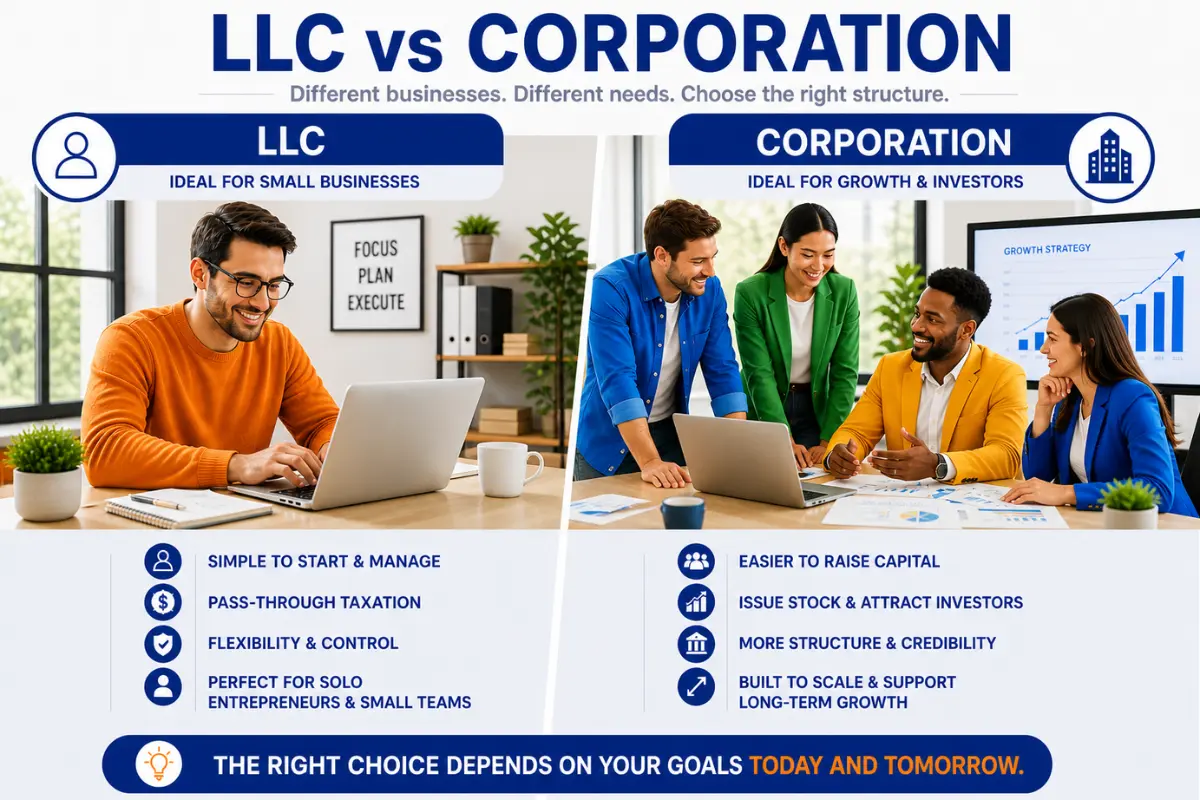
The business structure you choose affects everything from taxes to personal liability. As the SBA explains, "the business structure you choose influences everything from day-to-day operations to taxes and how much of your personal assets are at risk."
With that in mind, here are the key factors to consider when making your decision:
Income level. If you expect to be consistently profitable (often $60,000+ annually), an LLC with S corp election could save you on self-employment taxes.
Growth plans. If you are building toward outside investment or an IPO, a C corp may be worth the added structure. For steady organic growth, an LLC is more than enough.
Tax strategy. Evaluate your expected income, deductions, and long-term goals to determine which business structure offers the most tax efficiency over time.
Administrative complexity. Be honest about how much time and money you want to spend on compliance. LLCs are simpler. Corporations demand more.
The formation process is simpler than most people expect. Here is a quick overview of what is involved:
Make sure it is available in your state and meets naming requirements for your entity type.
LLCs file Articles of Organization; corporations file Articles of Incorporation. Both are submitted to your state's business filing office along with the required fee.
Every LLC and corporation is required to have a registered agent in their state. This is a person or service designated to receive legal documents and official notices on behalf of the business.
An Employer Identification Number (EIN) is required if you have employees, if your LLC is taxed as a corporation or partnership, and is effectively required to open a business bank account and file business taxes. Most new LLCs and all corporations need one.
LLCs use an operating agreement to outline ownership and management. Corporations use bylaws. These documents are essential for protecting your business and clarifying how decisions get made.
For a deeper dive into the LLC side of things, check out our complete guide on how to start an LLC.
Filing the wrong documents, missing a deadline, or skipping a required step can delay your launch or create legal headaches down the road. Working with a formation service like MyLLC takes that risk off your plate entirely.
Ready to take the next step? MyLLC makes formation simple. We handle the paperwork, keep your business compliant, and offer registered agent services so you can focus on building your business. Contact us today and we will help you get started the right way.
For most small business owners, an LLC is the better starting point. It offers liability protection, pass-through taxation, and far less administrative burden than a corporation. Corporations are better suited for businesses seeking outside investment or planning for rapid scaling with equity financing.
The main disadvantages of an LLC are that self-employment taxes apply to all profits by default, and it can be harder to attract investors compared to a corporation. Some states also charge higher fees or taxes on LLCs, so it is worth checking your state's rules before you form.
Yes. An LLC can elect to be taxed as an S corporation (via Form 2553) or C corporation (via Form 8832) by filing the appropriate forms with the IRS. Electing S corp taxation is especially common for profitable LLCs because it can reduce self-employment taxes while keeping the LLC's flexible management structure intact.
The four most common business structures in the United States are sole proprietorships, partnerships, limited liability companies (LLCs), and corporations (which include both C corps and S corps). Each carries different implications for taxes, liability, and management, so it is important to choose the one that fits your business goals.