

If you’ve recently started a business or are thinking about it, you’ve probably run into two important numbers: the EIN and the SSN. One belongs to you. The other belongs to your business. Mixing them up, or not knowing which to use and when, can cause real problems with the Internal Revenue Service, your bank, and your vendors. Understanding the difference between an EIN vs SSN is one of the first things every business owner should have clarity on.
Both are nine-digit numbers used for tax purposes, and both show up on government forms. But they serve very different purposes. Using the wrong one puts your personal finances at risk and can complicate your tax filings. MyLLC helps business owners navigate this every day, and we’re breaking down everything you need to know.
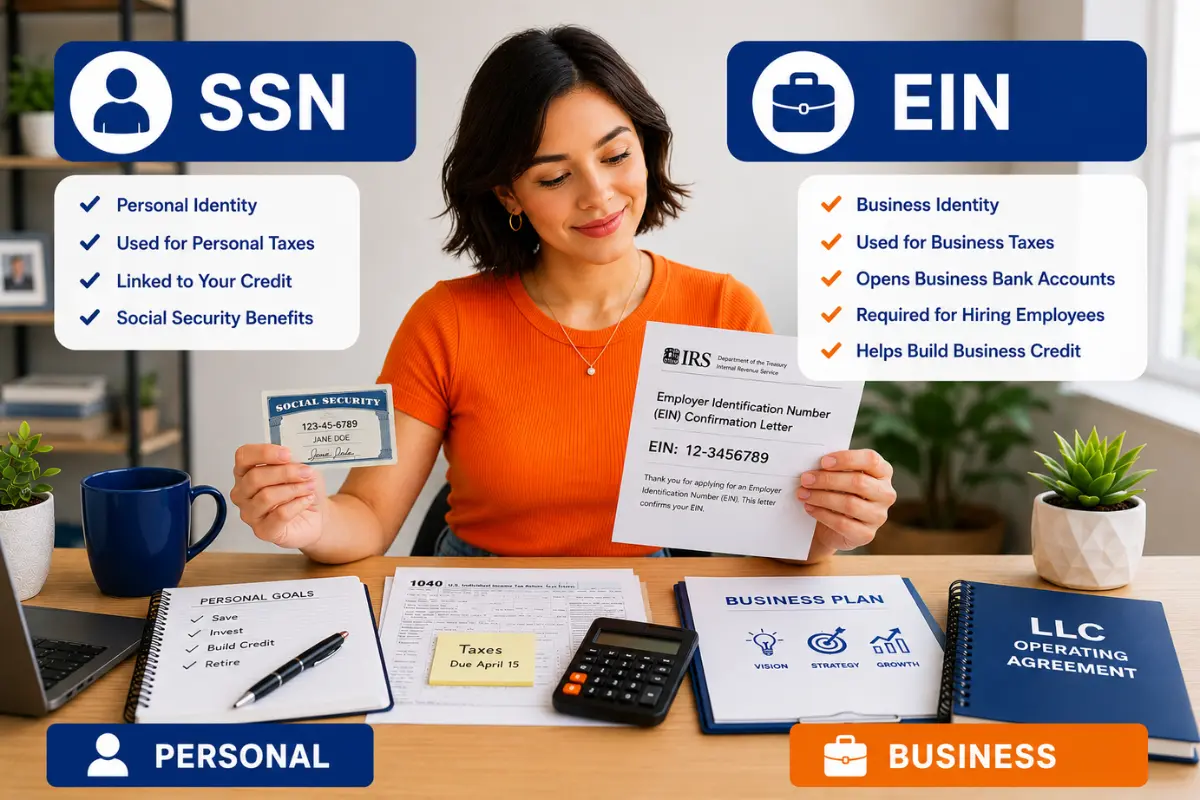
An Employer Identification Number (EIN) identifies business entities for federal tax purposes
A Social Security Number (SSN) identifies individual U.S. citizens and permanent residents
Most LLCs and all employers need an EIN; sole proprietors may use either depending on their situation
Using an EIN protects against identity theft and keeps your personal and business finances cleanly separated
Non-U.S. citizens who cannot get an SSN may need an Individual Taxpayer Identification Number (ITIN)
An Employer Identification Number (EIN) is a nine-digit number issued by the Internal Revenue Service to identify a business entity for federal tax purposes. You might also hear it called a Federal Tax Identification Number, a Federal Employer Identification Number, or a tax ID number. The format looks like this: XX-XXXXXXX, which distinguishes it from an SSN and tells financial institutions they’re dealing with a business, not an individual.
According to the IRS, an Employer Identification Number (EIN) is used to identify a business entity for federal tax purposes.
Once you have an EIN, it becomes your business’s primary identifier for tax reporting and financial activity:
Hiring employees and running payroll
Opening a business bank account
Filing business tax returns
Applying for licenses and permits
Building business credit with financial institutions
A Social Security Number (SSN) is a nine-digit number issued by the Social Security Administration (SSA) to U.S. citizens, permanent residents, and individuals with lawful alien status who are authorized to work in the U.S. The format is XXX-XX-XXXX. It was originally created to track earnings for Social Security benefits and has since become the standard personal tax ID for individuals filing a federal income tax return.
Your SSN touches virtually every part of your personal financial life:
According to the Social Security Administration, Social Security Numbers are used to track earnings and determine eligibility for Social Security benefits.
Here’s a quick side-by-side look at how these two numbers differ:
| Category | EIN | SSN |
|---|---|---|
| Who receives it | Business entities | Individual people |
| Issuing agency | Internal Revenue Service | Social Security Administration |
| Primary purpose | Business tax identification | Personal tax and identity |
| Number format | XX-XXXXXXX | XXX-XX-XXXX |
| Privacy | Shields personal SSN from exposure | High identity theft risk if shared |
| Business usage | Required for most business activity | Personal activity only |
Beyond format, the core difference is identity. Your SSN is tied to you personally, your personal credit, and your personal tax records. Your EIN is a separate tax identification number for your business, keeping business finances distinct from personal bank accounts and personal tax filings. Mixing the two creates messy books, complicates your income tax return, and can leave your personal assets exposed if your business faces a legal claim.
The answer depends on your LLC setup. Here’s how it breaks down:
Single-member LLCs without employees are not always required by the IRS to have an EIN. That said, most financial institutions require one before they’ll open a business bank account.
Multi-member LLCs must have an EIN because they file business tax returns as partnerships.
Any LLC that hires employees needs an EIN, no exceptions.
Whether you’re forming a single-member LLC or a multi-member LLC, we recommend getting an EIN regardless. It keeps your SSN off business paperwork and makes banking, tax filings, and vendor relationships much cleaner. Not sure which structure is right for you? Review your business structure options before you decide.
A single-member LLC without employees can sometimes use the owner’s SSN for certain federal tax filings. But most banks require an EIN to open a business account, and using your SSN for business purposes increases your identity theft exposure. If you’re learning how to start an LLC, getting your EIN is one of the key steps.
According to the IRS, sole proprietors without employees may use their Social Security Number for certain tax purposes, although many still obtain an EIN for privacy and business banking.
Freelancers and independent contractors without employees can use their SSN for tax purposes. Business income gets reported on Schedule C alongside your personal income tax return. For many people just starting out, this works fine in the short term.
Even when it’s not required, getting an EIN makes a real difference:
Identity theft protection: Share your EIN on W-9 forms and vendor paperwork instead of your SSN
Easier banking: Most financial institutions prefer or require an EIN to open a business bank account
Cleaner finances: Keeping personal and business finances separate simplifies your tax records from the start
A Taxpayer Identification Number (TIN) is a broad term the IRS uses for any number that identifies a taxpayer. It’s a category that includes EINs, SSNs, and Individual Taxpayer Identification Numbers (ITINs).
Here’s how the three fit together. Both EINs and SSNs are types of TINs. An EIN identifies a business. An SSN identifies an individual U.S. citizen or permanent resident. An ITIN is issued to foreign nationals and nonresident aliens who have U.S. tax obligations but do not qualify for an SSN based on their foreign status or immigration status. If you’re a foreign national running a U.S. business, you may need both an EIN for the business and an ITIN for your personal U.S. tax return.
The IRS considers EINs and SSNs to be different forms of taxpayer identification numbers (TINs) used for federal tax administration.
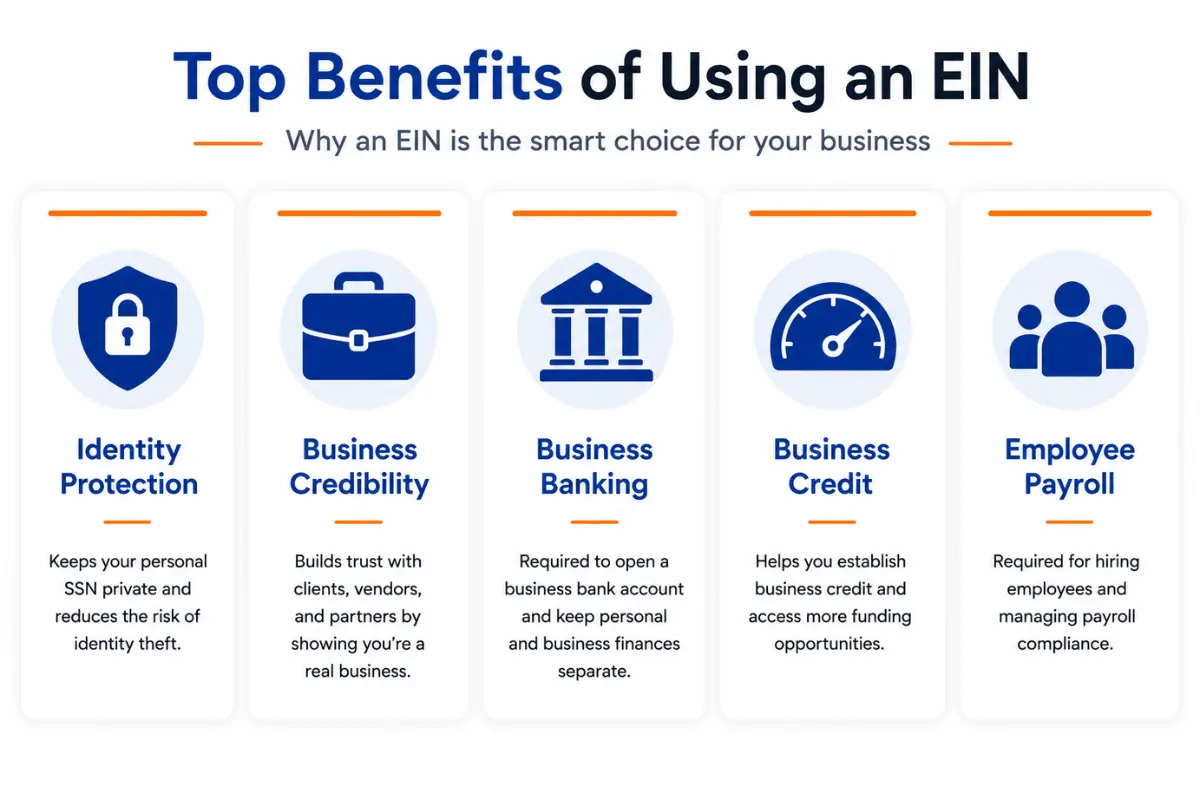
Every time you share your SSN with a client or vendor, you’re exposing sensitive personal information. Identity theft is a real risk for business owners whose SSN ends up on too many documents. An EIN gives you a business-specific number to share instead.
Using an EIN signals you’ve set your business up properly and helps keep personal and business finances separate. That matters when dealing with the IRS, applying for a loan, or demonstrating that your business is a legitimate standalone operation.
Most financial institutions require an EIN to open a business bank account. Keeping business bank accounts separate from personal bank accounts is a foundational step in running any legitimate operation. It also lets you build business credit under your EIN, separate from your personal credit.
The moment you hire employees, an EIN is mandatory. You’ll need it to report wages and stay compliant with federal tax laws. There is no workaround for this requirement.
The U.S. Small Business Administration notes that obtaining an EIN can help business owners separate personal and business finances while simplifying banking and hiring processes.
No. An EIN and an SSN cannot be the same number. They are formatted differently, issued by different government agencies, and serve entirely separate purposes. The Internal Revenue Service issues EINs for businesses. The Social Security Administration issues SSNs for individuals.
Some business owners assume that because a single-member LLC is treated as a disregarded entity for tax purposes, their SSN and EIN are interchangeable. They’re not. Each has its own registration, its own format, and its own place on IRS forms and financial documents. A sole proprietor using their SSN for business purposes does not convert that SSN into an EIN. It just means a personal tax ID is standing in temporarily, which is a situation most business owners are better off correcting sooner rather than later.
You’ll need an EIN in any of these situations:
Hiring employees and handling payroll tax reporting
Forming an LLC, partnership, or corporation
Opening a business bank account
Filing excise taxes or separate business tax returns
Operating as a foreign national or foreign entity with U.S. tax obligations
You can apply for an EIN directly through the IRS online application, but getting it right means having your business name, structure, address, and responsible party information all lined up first. One small error can create headaches down the road. That’s why many business owners choose to let professionals handle the process from the start. We take care of your EIN filing as part of our business formation services, so everything is set up correctly the first time. For a full picture of what’s involved in setting up your business the right way, check our guide on LLC costs.
Freelancers without employees can technically use their SSN for tax purposes. But we recommend getting an EIN anyway. It keeps your SSN off client paperwork, lowers your identity theft risk, and makes it easier to open a dedicated bank account as your income grows.
If you’ve formed an LLC, get an EIN. Financial institutions expect it, it protects your personal information, and it’s required the moment your LLC takes on employees. Multi-member LLCs must have one. Single-member LLCs are wise to get one from day one.
If you’re scaling up, hiring employees, or building business credit, an EIN is non-negotiable. It’s what allows you to keep your business finances separate from your personal finances as the stakes get higher.
You’ll always have an SSN, and as a business owner you’ll likely also have an EIN. Your SSN handles your personal income tax return and personal credit. Your EIN handles your business tax returns, payroll, and business account activity. If you’re a foreign national with U.S. business activity, you may also use an ITIN for personal U.S. tax obligations alongside your business EIN.
The difference between an EIN and an SSN comes down to this: one identifies you, one identifies your business. Keeping them separate protects your personal finances, simplifies your tax records, and sets your business up as a legitimate standalone operation. Whether you’re a sole proprietor, an LLC owner, or a growing company ready to hire, getting an EIN is a simple step with lasting benefits.
Figuring out your EIN is just one piece of the puzzle. Between choosing the right business structure, filing your formation documents, and staying compliant, there’s a lot to keep track of. We make the process straightforward. From LLC formation to EIN filing and registered agent services, our team handles the details so you can focus on your business. Contact us today to get started.
In some situations, yes. Sole proprietors and single-member LLCs without employees may use their SSN for certain tax filings. But an EIN is almost always the better choice for privacy and keeping personal and business finances separate.
Yes. An EIN keeps your SSN off business documents, which reduces your identity theft risk. Your SSN is tied to your personal credit and full financial history, so protecting it matters.
Not always by IRS rules, but most financial institutions require one to open a business bank account.
No. An EIN handles your business tax obligations, but your SSN is still required for your personal income tax return and individual identity verification.
Yes. The IRS issues EINs through their online application, typically immediately. You can also apply by fax or mail using IRS Form SS-4.
TIN (Taxpayer Identification Number) is the umbrella term covering EINs, SSNs, and ITINs. An EIN is for businesses. An SSN is for individual U.S. citizens and permanent residents. An ITIN is for foreign nationals and nonresident aliens with U.S. tax obligations who do not qualify for an SSN.
Most financial institutions require an EIN to open a business bank account, even for single-member LLCs. Some allow sole proprietors to use their SSN, but that is increasingly uncommon.
We recommend it. An EIN keeps your SSN off W-9 forms, makes it easier to open a dedicated bank account, and gives your business a more professional footprint.