

You've built a solid business foundation, but your legal name doesn't capture what you actually do. "Johnson Enterprises, LLC" doesn't tell customers you specialize in organic pet treats. "Smith & Associates" gives no hint you're running three thriving coffee shops under different brands.
This is where DBAs change everything. The right business name can mean the difference between customers remembering you or scrolling past. It's the gateway to opening business bank accounts, signing contracts under a professional brand, and expanding into new markets without restructuring your entire company.
MyLLC’s guide breaks down everything you need to know about DBAs, including what they are, when you might need one, and how to register without the headaches. By the end, you'll know whether a DBA is right for your business and the steps involved in getting one.
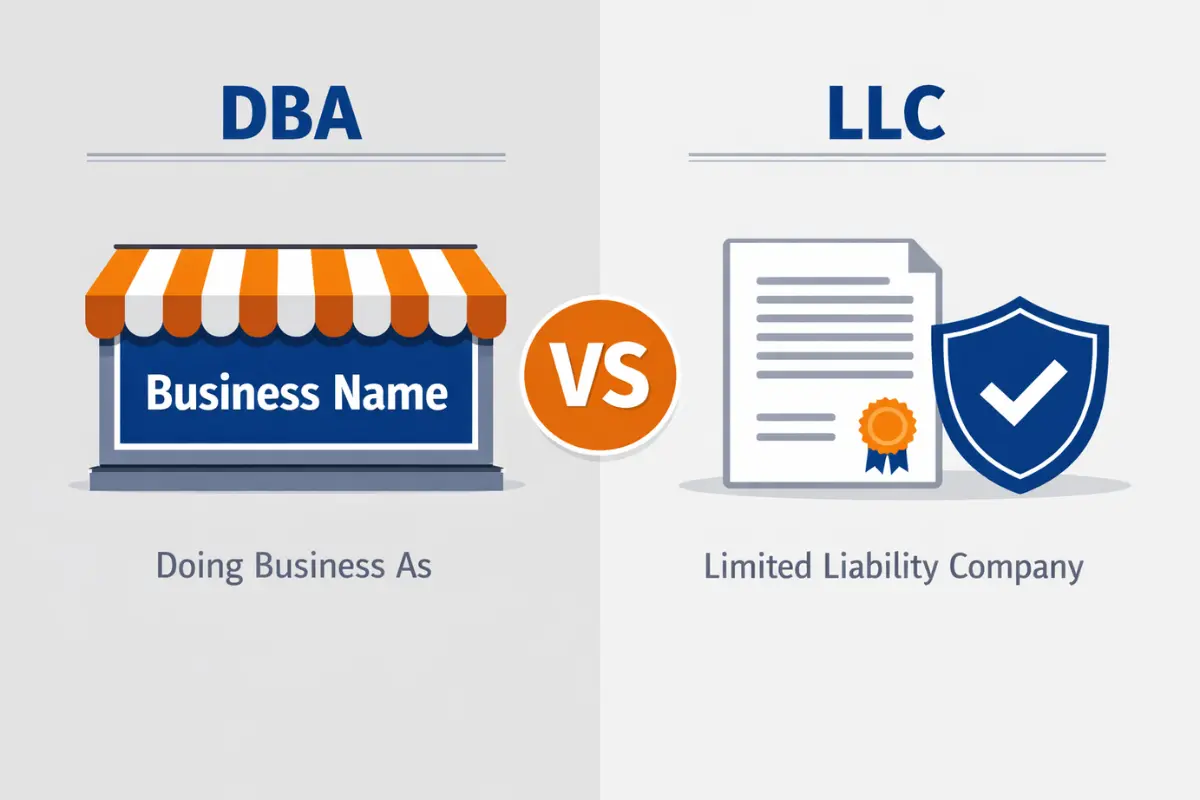
DBA stands for “doing business as,” allowing any business entity to operate under a name different from its legal business name.
A DBA is not a separate legal entity - it’s just a name registration that doesn’t provide liability protection.
DBAs are used by all business structures including sole proprietorships, partnerships, LLCs, and corporations to create professional brand names or operate multiple ventures.
Registration requirements vary by state, but most DBAs must be filed with your county or state and renewed periodically.
DBAs help with branding and banking but don’t change your tax structure or provide additional legal protection beyond what your entity type already offers.
What does DBA stand for? DBA stands for “doing business as,” and it’s a legal designation that allows any business entity to operate under a name different from its registered legal name. It’s also called a fictitious business name, assumed name, or trade name depending on your state.
According to the U.S. Small Business Administration, “If your business uses a name different from your own name, you may have to register it with your state government.” A DBA, or “doing business as,” allows you to operate under a name different from your legal business name.”
Here’s the critical part: a DBA is not a business structure. It doesn’t create a new legal entity or provide liability protection. Instead, it’s simply a name registration that lets you legally conduct business under a brand name that’s more appealing than your legal name. Your legal business name is your official identity in government records, while your DBA is the public-facing name customers see.
The DBA abbreviation reflects how a business operates under a name that is different from its legal name. In many jurisdictions, a DBA serves several practical purposes for a wide range of business entity types.
Professional branding: A business can use a DBA to operate under a marketable or professional name instead of its formal legal name when permitted by state and local law.
Multiple business lines: A single business entity can often register more than one DBA to operate several distinct brands under the same underlying legal and tax structure, subject to state and local registration rules.
Banking requirements: Many financial institutions require proof of a DBA (or similar documentation) to open a business bank account under a trade name that is different from the owner’s or entity’s legal name.
Legal compliance: In many states, businesses must register a DBA (also called a fictitious, assumed, or trade name) when they operate under a name other than their legal name, and in some areas this filing occurs at the county or city level.
As the U.S. Chamber of Commerce explains, “DBA stands for ‘doing business as.’ It’s a way to give your business a name other than your own.” The DBA meaning in business centers on naming flexibility: it lets a business create a public-facing brand identity without forming a new legal entity or changing its existing business structure.
When you see “DBA” in a company name, it indicates the trade name a business operates under, which differs from its legal registered name.
Sole Proprietor: Jennifer Martinez starts a freelance graphic design business. Her legal name is simply “Jennifer Martinez” as a sole proprietor. She registers a DBA called “Creative Spark Design Studio.” Now she can market her services, sign contracts, and open a business bank account under this professional name. On legal documents, it appears as: Jennifer Martinez DBA Creative Spark Design Studio.
LLC with Multiple Brands: A restaurant owner forms “Smith Hospitality Group, LLC” as their legal entity. They register three DBAs: “Downtown Bistro,” “Waterfront Grill,” and “Main Street Cafe.” Each location operates under its own brand name, but all are legally owned by the same LLC.
According to Forbes, “A DBA doesn’t create a new legal entity, but it allows a business to operate and market itself under a different name.”
Understanding what DBA means in a business context is important, but so is knowing why it matters in practice.
A DBA can make a business’s name more descriptive and marketable than an owner’s personal or bare legal name. It is commonly used on business cards, websites, invoices, signage, and, when allowed by the bank and properly documented, business bank accounts. A clear, memorable DBA helps customers recognize and remember who they are doing business with.
Beyond branding, DBAs have compliance implications that vary by state and locality. In many jurisdictions, businesses must register a DBA (also called a fictitious, assumed, or trade name) if they operate under a name other than their legal personal or entity name. Many banks require proof of a DBA or similar registration if you want to title a business account in a trade name instead of the exact legal name.
In some states, failing to register a required DBA can lead to penalties or limit your ability to enforce contracts under that name until the registration is corrected. Registering a DBA creates a public record that links the trade name to the underlying owner or entity, which helps regulators, customers, and business partners identify who is legally responsible for the business.
One common question is about DBA and LLC differences.
DBA: A DBA (also called a fictitious, assumed, or trade name) is a registered name that allows a business to operate under a name different from its legal name. It is a naming tool only and does not create a separate legal entity or provide liability protection.
LLC: A limited liability company is a formal business structure that creates a separate legal entity, which can shield an owner’s personal assets from many business debts and lawsuits when properly formed and maintained. It may also offer flexibility in how the business is taxed.
The key distinction is that an LLC is a business entity type that can provide limited liability and specific tax treatment, while a DBA is simply a registered name that can be used with various business structures (such as a sole proprietorship, partnership, LLC, or corporation) and does not change the underlying legal or tax status of the business.
You can use both together. An LLC can register one or more DBAs so it can operate multiple brands or business lines under the same legal entity and tax structure, instead of forming a separate LLC for each name, as long as state and local rules are followed.
A DBA is not a substitute for an LLC or any other entity type. In practice, you first choose your business structure (for example, sole proprietorship, partnership, LLC, or corporation) and then decide whether you need a DBA to operate under a different public-facing name.
If you are a sole proprietor or in a partnership and are deciding whether to form an LLC, that decision is primarily about liability protection, tax treatment, and formality requirements, not about what you can call the business. Many owners choose to form an LLC as their business grows to help separate personal and business liability. After that, if they want to use a different name or run multiple brands under the same entity, they may register one or more DBAs as permitted by their state and local laws.
The basic DBA registration steps are similar for many business types, but specific requirements depend on your state and local rules.
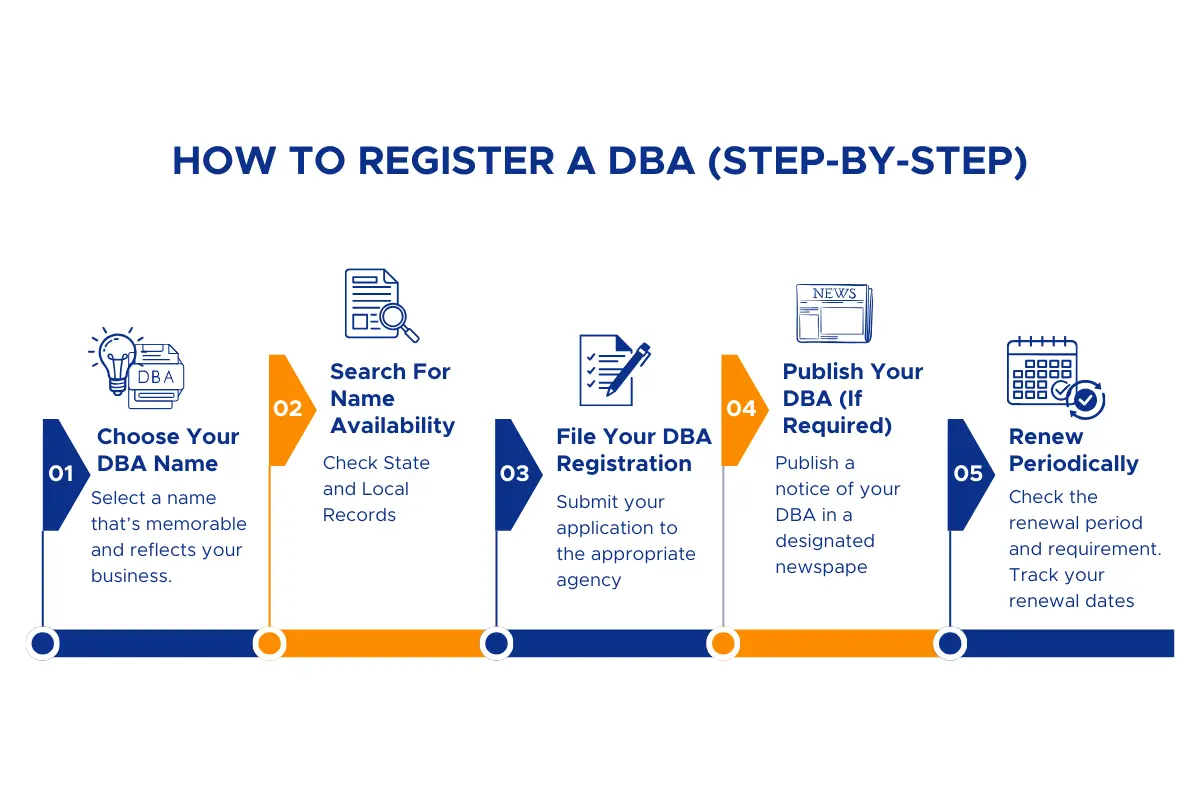
Select a name that’s memorable, professional, and reflects your business. Verify it’s available by checking your state’s business name database.
Search the relevant state and, where applicable, county or city records to confirm that your proposed DBA is not already registered by another business.
Submit your application to the appropriate agency, such as your county clerk’s office, state Secretary of State, or both. Filing fees typically range from $10 to $100.
Some states or counties require you to publish a notice of your DBA in a designated newspaper for a set period before or after approval. If publication is required, you must follow the specific instructions and deadlines for your jurisdiction.
Many DBA registrations are valid for a fixed term, such as three to five years, and must be renewed to stay in effect. Check the renewal period and requirements in your state or county and track your renewal dates.
Skipping the name search: Filing A DBA without checking for existing registrations can lead to rejections, conflicts, waste of time and money.
Forgetting to renew: Letting a DBA lapse can cause compliance issues and may create problems with banks or vendors that rely on your registered name.
Filing in the wrong jurisdiction: Some areas require county‑level filings, others require state‑level filings, and some require both, so it is important to follow your local rules.
Confusing a DBA with entity formation: A DBA does not create a separate legal entity or provide liability protection. Choose an appropriate business structure first, and then use a DBA if you need a different public‑facing name.
You now understand what DBA stands for and why it matters. A DBA, or “doing business as,” is a way for a business to use a name other than its legal name while keeping the same underlying legal structure. It allows you to present a more descriptive or professional brand without forming a new entity or changing how your existing entity is organized.
The practical meaning of a DBA in business is flexibility in naming and branding. Whether you operate as a sole proprietorship, partnership, LLC, or corporation, you may be able to register a DBA to create a public-facing brand name for your products, services, or separate business lines, depending on your state’s rules.
Remember: A DBA is a name registration, not a business structure. It does not provide liability protection, change your tax classification, or alter your entity type. In many states, you must register a DBA or trade name if you operate under a name other than your legal personal or entity name. Subject to state and industry-specific requirements, a single legal entity can often register multiple DBAs to manage more than one brand under one legal structure.
Navigating state and county DBA requirements, publication rules, and deadlines can be confusing. MyLLC’s team takes care of the process for you, from confirming your business name and preparing the right forms for your jurisdiction to handling filing details and helping you stay on top of renewals.
We have over 20 years of experience helping businesses with formation and compliance. Contact MyLLC today for DBA filing help, answers to your questions, and support meeting your state’s specific requirements.
No, you cannot register a DBA using the same name as another business already operating in your jurisdiction. Before you file a DBA, you must search the public record at your county clerk's office or state agency to verify your desired fictitious business name isn't already registered. Using the same name as an existing business entity can create legal issues, customer confusion, and potential trademark violations. Most state governments require name availability confirmation as part of the DBA application process. If your preferred trade name is taken, you'll need to choose an alternative that distinguishes your business identity in the local area.
An Employer Identification Number isn't required to file a DBA, but you may need one to open business bank accounts under your fictitious name. Sole proprietors operating under their own name can often use their Social Security Number, but once you register a DBA and want to conduct business under that trade name, most banks require either an EIN or DBA certificate to open business accounts. If you plan to hire employees, operate as anything other than a sole proprietorship, or maintain good standing with business advisors and lenders, obtaining an EIN from the IRS is recommended. The combination of a DBA registration and EIN gives you full functionality to transact business professionally.
A DBA certificate simply allows you to operate under a fictitious business name—it doesn't change your underlying business structure or provide legal protection. When you file a DBA, you're still the same legal entity (whether sole proprietorship, general partnership, or corporation) with the same liability exposure. In contrast, forming a new legal entity like an LLC or corporation creates a separate business entity that provides liability protection for your personal assets. A DBA filing costs significantly less (typically a small filing fee) than creating a new entity type, but it also offers none of the legal benefits. Many business owners maintain their existing legal business structure while using a DBA for brand names and marketing materials.
Yes, a parent company or any legal business can register multiple DBAs to operate different product lines, enter a new market, or target different customer segments under distinct brand names. This strategy is common for business owners who want to maintain separate business identities without creating multiple legal entities. For example, one LLC can file a DBA for a restaurant, another DBA for a catering service, and a third DBA for a food truck—all under the company's legal name. Each DBA filing requires its own application and filing fee, and you'll need to publish a public notice for each fictitious business name in a local newspaper if your state requires it. This approach lets you build multiple business brands while keeping your entity type and legal structure simple.
DBA registration establishes your right to use a trade name in your local area and creates a public record of your assumed name, but it doesn't provide trademark protection or prevent others outside your jurisdiction from using similar names. When you register a DBA at the county level or with your state government, you're primarily ensuring you can legally conduct business and open business accounts under that fictitious name. For stronger protection of your business's brand across state lines and in online filing of new markets, you'd need to register a trademark with the U.S. Patent and Trademark Office. However, DBA registration does help establish your business identity and demonstrates to business advisors, lenders, and customers that you're operating in good standing. Some business owners eventually file for trademark protection after their DBA is established and their business trades successfully under that catchy name.