

What if your business could legally operate in multiple states without risking everything you've built? Most business owners don't realize they're breaking the law when they expand across state lines without proper registration. The consequence? Hefty fines, lawsuits you can't defend against, and losing access to state courts when you need them most.
The solution is simpler than you think. When you register as a foreign entity in states where you're doing business, you protect your company, unlock legal rights, and avoid expensive penalties. Whether you're running an LLC, corporation, or partnership that operates across state lines, understanding foreign qualification isn't just smart, it's essential.
MyLLC handles foreign qualification for businesses expanding across state lines, managing the paperwork and compliance requirements so you can focus on growth. We're about to show you exactly when you need to register, what benefits you'll gain, and how the process works.

Foreign qualification protects your legal standing: Operating without registration means you can't sue in state courts, face fines up to $10,000, and risk personal liability for business debts.
Register when doing substantial business: Physical presence, employees, bank accounts, or significant revenue in another state typically trigger foreign qualification requirements.
The process is straightforward: File a Certificate of Authority, appoint a registered agent, pay state fees (usually $100-$300), and maintain annual compliance.
Benefits extend beyond compliance: Registration gives you tax advantages, enhanced credibility, access to state resources, and protection for your personal assets.
Let's clear up the confusion right away. A "foreign entity" doesn't mean international; it simply means your business was formed in one state but operates in another. If you formed your LLC in Delaware but run operations in California, you're a foreign entity in California.
A foreign entity is any business legally formed in one state but conducting business in another state. Your LLC might be "domestic" in its home state but becomes "foreign" the moment it operates elsewhere.
According to the U.S. Small Business Administration, "If you do business in a state other than the one where you formed your business, you may need to register that business in the new state as a foreign entity."
Operating without foreign qualification can create serious legal and financial consequences. You may be barred from maintaining a lawsuit in that state’s courts, so if a client does not pay, you might not be able to pursue the case there until you register and resolve the violation. States can impose fines starting at $500 and reaching $10,000 or more, plus back fees and taxes for each year you operated without registering. Ignoring registration requirements can also be used as evidence that you are not respecting corporate formalities, which may increase the risk of a court piercing the corporate veil in a dispute.
Real-world example: A Texas marketing agency expanded to Colorado without registering. When a Denver client refused to pay a $25,000 invoice, the agency couldn't file a lawsuit until they completed foreign qualification and paid $3,500 in back penalties.
Registration transforms your business from an unknown entity to a recognized legal presence. You gain access to state court systems to enforce contracts, collect payments, and defend lawsuits. State databases show your business as properly registered, building trust with clients who verify credentials before signing contracts.
Banks require foreign qualification for business accounts in many states. Without it, you're stuck using personal accounts or out-of-state banks, which can create tax complications and make your business appear unprofessional when checks come from a different state than your business address.
Foreign qualification opens doors for unregistered businesses. Government contracts often require state registration. Large corporate clients check registration during vendor approval. Professional licenses in construction, healthcare, or real estate often require it.
The liability shield protecting your personal assets only works when you maintain compliance across all states where you operate. Courts can pierce your corporate veil and hold you personally liable when you ignore foreign qualification requirements, effectively treating your LLC or corporation as if it doesn't exist.
Proper registration maintains the legal separation between you and your business. When lawsuits arise or debts accumulate, your home, savings, and personal property remain protected.
Foreign qualification lets you claim legitimate business expenses in each state where you operate. You can deduct costs for offices, equipment, employee wages, and travel related to business activities in that state. Without registration, the IRS may question these deductions during audits.
Registration also prevents double taxation issues. When you're properly registered, states can coordinate tax obligations rather than both taxing the same income. Some states offer tax credits for taxes paid to other states, but only when you're registered in both locations.
According to Rocket Lawyer, “A company must register as a foreign entity when it meets a state’s legal definition of ‘doing business’ in that state.” When your activities in another state meet that threshold, you must complete the foreign qualification process to operate legally there.
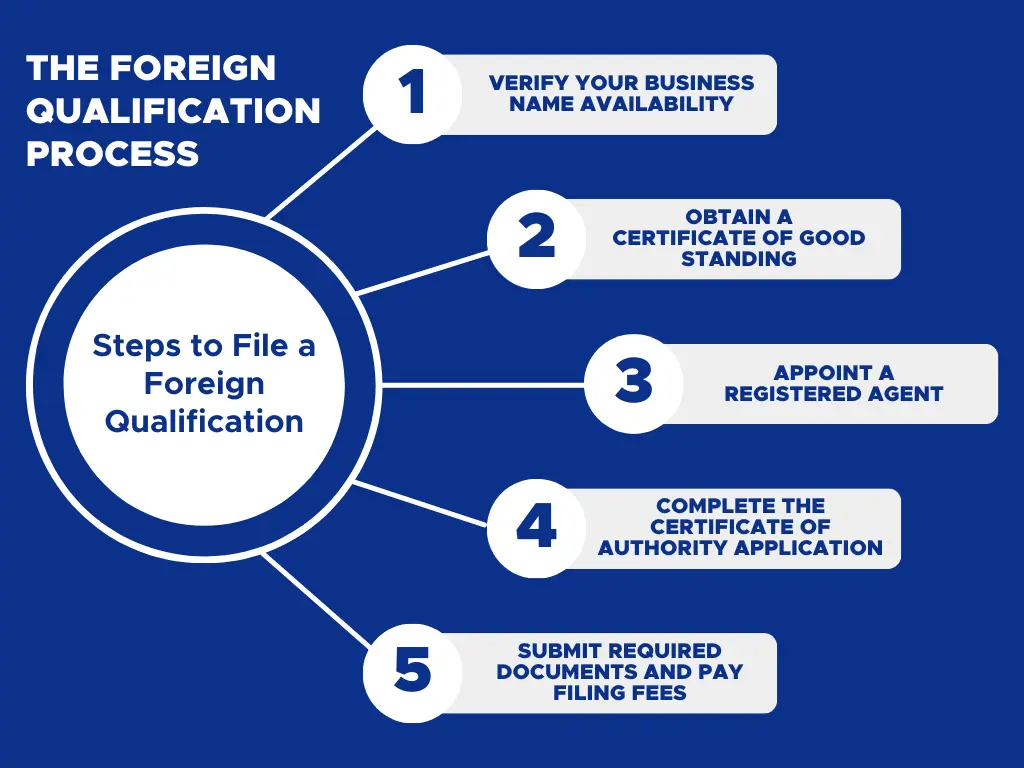
The foreign registration process follows a clear path:
Check if your business name is available in the new state by searching the Secretary of State's business database. If another company already uses your name, you'll need to file under a different name using a "doing business as" (DBA) registration.
Request a Certificate of Good Standing from your home state proving your business is current with all requirements there. This document must typically be issued within the past 30-60 days of your foreign qualification filing.
Choose a registered agent with a physical address in the new state. This person or company will receive legal documents, tax notices, and official correspondence on your business's behalf.
File your Certificate of Authority (also called Application for Registration) with the new state's Secretary of State office. This document includes your business name, home state, formation date, registered agent information, and business purpose.
Submit your application along with your Certificate of Good Standing, original formation documents, and the filing fee, which typically ranges from $100 to $300 depending on the state.
You'll need several documents to complete foreign qualification. Your original formation documents (Articles of Organization for LLCs or Articles of Incorporation for corporations) prove your business exists. A Certificate of Good Standing from your home state, issued within the past 30-60 days, shows your business is current on all filings and fees.
The Certificate of Authority application requires your business address, registered agent details in the new state, names of members or officers, and your business purpose. Some states ask for additional information like your federal Employer Identification Number (EIN) or estimated annual revenue.
Every state requires you to appoint a registered agent, a person or company authorized to receive legal documents, tax notices, and official correspondence on your business's behalf. Your registered agent must have a physical address in that state and be available during business hours.
You can serve as your own registered agent if you have a physical presence in the state, but this creates problems. Legal documents might arrive when you're unavailable, your personal address becomes public record, and you must be present during all business hours.
Professional registered agent services solve these issues. MyLLC provides a consistent business address, helps you avoid missing important documents, maintains privacy by keeping your home address off public records, and can handle service in multiple states if you expand further.
Foreign qualification is the legal process of registering your out-of-state business to operate in a new state. It creates official recognition that your business exists and has permission to conduct business activities there.
This differs from simply having a mailing address or virtual office in another state. An address doesn't create legal authority to do business, only proper registration does that.
Your company address and your foreign qualification serve different roles. A business address gives you a place to receive mail, meet clients, and appear in online listings or directories, which helps build local presence and credibility.
A business address alone does not satisfy state legal requirements. You still need to complete foreign qualification if you are carrying out significant business activities in that state, even if you already use a local address there.
Relying only on a company address without foreign qualification may look cheaper and simpler at first because you avoid filing fees and ongoing compliance costs. In reality, you are operating illegally, exposing yourself to growing penalties, losing access to that state’s courts, and increasing the risk that your liability protection is challenged.
By contrast, properly completing foreign qualification costs more upfront but gives you legal protection, access to the courts, stronger credibility with clients and banks, and clearer tax treatment. The money you invest in compliance helps you avoid fines and legal problems that can easily exceed the cost of registration.
Business size does not determine registration requirements, your activities do. A one-person consulting LLC needs foreign qualification if they regularly work with clients in another state. A small e-commerce business needs registration if they maintain inventory in a warehouse across state lines.
States look at factors like physical presence, employee locations, contract performance, and revenue sources. Small businesses trigger these factors just as easily as large corporations.
The process involves paperwork, but it's not overwhelming. Most states use straightforward forms asking basic questions about your business. The hardest part is often just getting a Certificate of Good Standing from your home state.
Professional services handle the complexity for you. We manage document preparation, filing deadlines, registered agent requirements, and ongoing compliance so you can focus on running your business instead of navigating state bureaucracy.
Foreign registration typically costs around $200–$500 per state to set up, plus about $50–$300 per year for reports and registered agent fees. Those amounts are usually small compared to potential penalties of $500–$10,000 or more, along with back fees for years of non-compliance.
The real expense of skipping foreign qualification appears when you cannot sue a non-paying client, lose a major contract because you are not properly registered, or face personal liability after a court pierces your corporate veil. In practical terms, registration acts like a form of insurance that helps you avoid much larger legal and financial problems later.

Foreign qualification protects your business when operating across state lines. You gain legal standing to enforce contracts and defend lawsuits, maintain liability protection for your personal assets, access tax advantages and legitimate expense deductions, and build credibility with clients, banks, and partners who verify your registration status.
Don't wait for a penalty notice or legal problem to force your hand. If you're doing business in multiple states, start the foreign qualification process now. The cost and effort are minimal compared to the protection and opportunities you'll gain.
MyLLC can handle foreign qualification for businesses expanding across state lines, taking care of the paperwork, compliance requirements, and registered agent services so you can concentrate on running your business. Contact MyLLC today to make sure your business is properly registered in every state where you operate.
It depends on your activities. Simply selling products online to customers in another state typically doesn't trigger foreign qualification requirements. However, you may need to register if you maintain inventory in a warehouse, have employees working there, operate a physical storefront, or have significant nexus through sales volume or frequency.
Processing times vary by state, typically ranging from one to four weeks. Some states offer expedited processing for an additional fee, reducing approval time to 24-48 hours. The timeline also depends on how quickly you gather required documents like your Certificate of Good Standing.
Yes, if you stop doing business in a state, you can file a Certificate of Withdrawal to end your foreign qualification. This closes your registration, stops annual report requirements, and prevents future fees. However, you must first pay all outstanding taxes, fees, and penalties before the state will approve your withdrawal.
Register as soon as possible to minimize penalties. Most states will require you to pay back fees for years you operated without registration, plus late penalties. However, proactively registering is far better than waiting for the state to discover your non-compliance and impose maximum fines. Once registered, you regain legal standing and liability protection going forward.
Most states require foreign qualification when your business entity maintains a physical presence, such as maintaining offices, owning real or personal property, or holding meetings in that state. Other triggers include maintaining bank accounts with financial institutions, hiring employees or independent contractors, conducting business through a principal office location, or transacting business beyond isolated transactions. Simply engaging in interstate commerce or obtaining orders that are accepted outside the foreign state typically doesn't trigger registration. Each particular state defines "conducting business" differently, so what requires registration in one state may not in another. Activities like enforcing mortgages, collecting debts, or acquiring indebtedness secured by property in the state usually require registration, while isolated transactions completed remotely generally don't.
Foreign qualification applies to many entity types, including limited liability companies, corporations, limited liability partnerships, limited partnerships, and nonprofit corporations. Each must register when doing business across state lines, generally by filing a certificate of authority with the secretary of state and appointing a registered agent with a physical address in that state. Nonprofits may have extra documentation requirements, and professional firms operating as LLPs face the same foreign qualification obligations when they do business outside their formation state.
You'll need a certificate of good standing (also called a certificate of existence in some states) from your formation state, showing you are current on taxes, reports, and corporate formalities. This certificate, usually issued by your home state's secretary of state within 30–60 days of your foreign filing, is often required along with certified copies of your original formation documents. Many states let you request the certificate and submit your foreign registration online, sometimes with optional expedited processing for an extra fee. Before requesting documents, confirm that your registered agent and principal office information are up to date in your home state records.
If your business name is already taken in the state where you want to operate, you can register under a fictitious name (also called a DBA or "doing business as" name). You file the certificate of authority using your legal entity name from your home state, and also register the fictitious name you will use in that state. This lets you maintain your brand while meeting name availability rules, but the fictitious name filing fee is separate from your foreign qualification fee. You must then use the fictitious name consistently on all records, bank accounts, and legal documents in that state, and make sure your registered agent is aware of both names.