
What if one overlooked filing could quietly shut down your business?
An annual report is a required state filing that confirms your business’s legal information and keeps it in good standing. Yet many business owners don’t realize how critical this single document is until they’re hit with late fees, loss of good standing, or administrative dissolution.
This guide explains what an annual report is, who must file, and how to stay compliant in 2026 so you can protect everything you’ve built.
Annual reports maintain good standing: This comprehensive document confirms your company's legal status, enabling you to legally operate and conduct business within the state.
Most registered business entities must file: Limited liability companies, corporations, and nonprofit corporations are typically required to file an annual report, though annual report requirements vary significantly by state.
Missing filing deadlines carries consequences: Late fees, loss of good standing, and administrative dissolution may result from failing to file annually by the designated due date.
Filing fees range from $20 to $500: State fees and associated fees depend on your jurisdiction and business type.
Professional services simplify compliance requirements: Utilizing a filing service ensures filing deadlines are met, helping you maintain good standing and avoid penalties.
An annual report is a comprehensive document that a business entity submits to the state to verify that company information remains current and accurate. This filing serves as a yearly verification that updates your business information and business addresses in official state records.
The U.S. Chamber of Commerce explains that a business annual report provides key information about the company's legal status, location, leadership, and business operations so state agencies and the public have accurate details.
Most limited liability companies, corporations, nonprofit corporations, and foreign entities registered to conduct business within a state are required to file annual reports. While filing requirements vary by state law, the fundamental purpose remains consistent: maintaining current official records so companies operating within the state can be properly documented.
A standard annual report typically includes your principal office address, registered agent and registered office address, ownership updates, and officer information. LLC members and managers are responsible for ensuring this required information remains accurate. Certain states may also request financial information or NAICS codes for classification purposes.
For publicly traded companies, the requirements extend further. According to the Securities and Exchange Commission(SEC), annual reports and Form 10-K filings provide financial data including a balance sheet, income statement, and cash flow statement detailing the company's performance and financial performance. Additional information regarding SEC annual report (Form 10-K) requirements is available on the SEC website. Private companies are subject to simpler state filing requirements that focus primarily on business addresses and legal requirements.
States require reports to maintain accurate records for tax collection, legal proceedings, and regulatory oversight of commercial activity within their jurisdictions.
Submitting your annual report is essential for maintaining your business in good standing with the state. Good standing status enables your company to legally operate, establish accounts with financial institutions, renew business licenses, secure financing, and expand operations to conduct business in additional states.
Failure to file annual reports results in accumulating late fees. Subsequently, your business loses good standing status. Continued non-compliance leads to administrative dissolution, which terminates your LLC's limited liability protection and exposes your personal assets to business-related debts and liabilities.
According to the U.S. Small Business Administration, maintaining compliance with state regulations is essential for preserving your limited liability protection and safeguarding personal assets from business liabilities.
Limited liability companies are required to file an LLC annual report in most jurisdictions. This annual filing verifies your registered agent, principal office address, and member information. Filing fees generally range from $25 to $150, depending on the state.
Corporations are subject to similar filing requirements, often with additional officer disclosure obligations. Certain states impose higher required fees for corporations. Both business types must maintain good standing through timely annual report filing to preserve limited liability protections.
Nonprofit corporations are also obligated to file annual reports to maintain their limited liability status, although fees are frequently reduced or waived. Limited partnerships and limited liability partnerships have distinct legal requirements established under state law.
Foreign entities, or registered business entities operating in a state other than their state of formation, must file annual reports in each state where they conduct business to remain compliant.
Arizona, Missouri, New Mexico, and Ohio do not require LLCs to file annual or biennial reports or pay related fees.
Other entity types in these states (such as corporations or nonprofits) often still have annual or biennial report obligations, so requirements vary by entity.
Several states use biennial reports instead of annual reports for some or all entities.
Because rules differ by both state and entity type, business owners should always review their own state’s statutes or Secretary of State guidance to confirm specific compliance requirements.
Most annual reports require your registered agent's name and registered office address, principal office address and additional business addresses, ownership updates, and manager or director information. Submitting incorrect information may result in processing delays or rejection of your filing.
Filing requirements vary significantly by state. Florida requires your FEIN along with detailed address information. California mandates separate forms for officer disclosures. Wyoming and Delaware request minimal information. Some states also require financial information or financial data for franchise tax calculations.
States use several standard methods to set annual report due dates. Many use a fixed calendar deadline (such as a specific day in a particular month for all entities), while others base the due date on the entity’s formation or registration anniversary, and some tie it to a fiscal or tax-year schedule. Because rules can differ by state and entity type, businesses need to confirm which model applies in each jurisdiction where they operate.
In Washington, LLC annual reports are due each year by the last day of the LLC’s anniversary month. Some other states use less typical fixed dates (for example, a particular day in a given month or a deadline tied to a tax filing), so business owners should identify their specific requirements and set reminders well in advance to avoid late fees and loss of good standing.
Failure to meet your annual report deadline results in late fees ranging from $25 to several hundred dollars. Your business subsequently loses good standing, creating obstacles to standard business operations such as executing contracts or establishing accounts with financial institutions.
Filing late or continued non-compliance results in administrative dissolution. Reinstatement costs substantially exceed original filing fees, and the loss of limited liability protection places personal assets at risk from business-related debts.
If you have missed a due date, file an annual report immediately to minimize penalties. If dissolution has occurred, you may need to submit an amended annual report along with back filings. Consider engaging a professional service for complex filings and assistance with tracking deadlines moving forward.
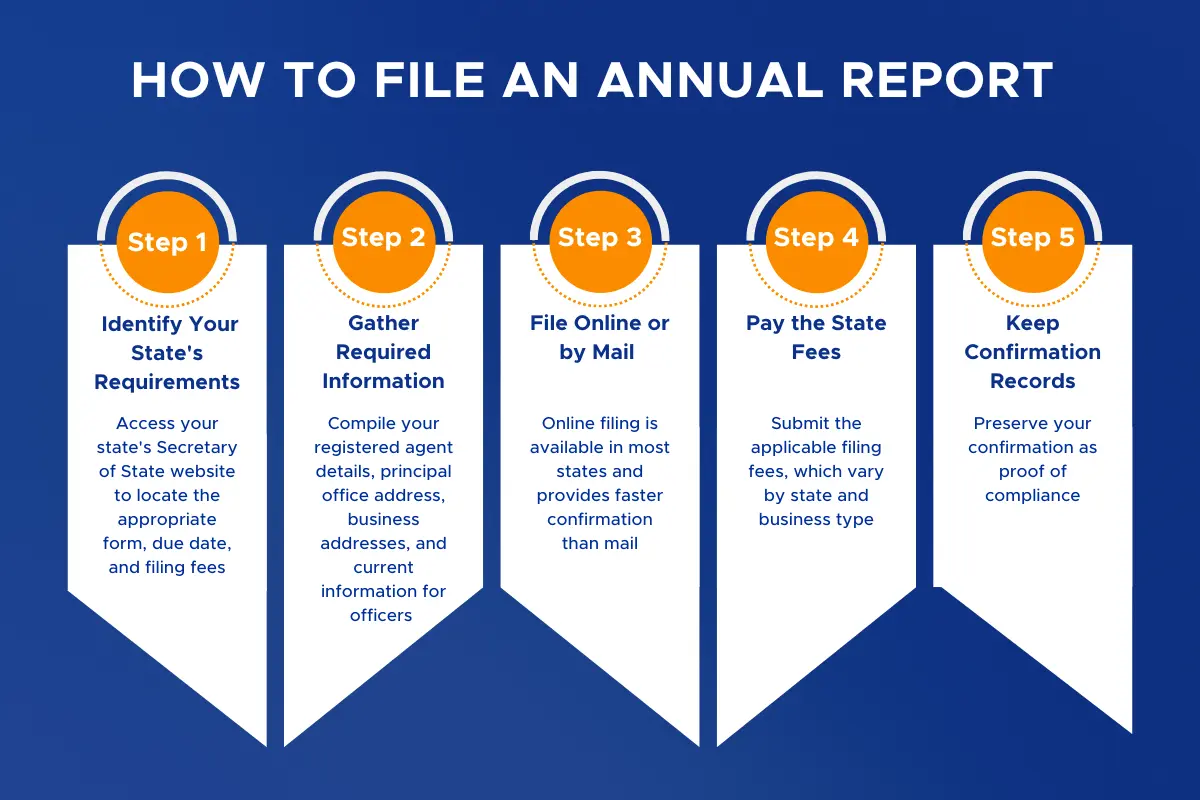
Access your state's Secretary of State website to locate the appropriate form, due date, and filing fees. Understanding the filing process in advance helps you avoid penalties and file annually by the required deadline.
Compile your registered agent details, principal office address, business addresses, and current information for officers or LLC members. Having required information prepared in advance streamlines the filing process.
Most states permit reports to be filed online, providing immediate confirmation of receipt. Some jurisdictions accept paper filing by mail—include a money order for required fees. Online filing typically offers faster processing.
Submit the applicable filing fees, which vary by state and business type. Some jurisdictions charge a flat fee while others calculate costs based on revenue or authorized shares. Retain your receipt for documentation purposes.
Preserve your confirmation as proof of compliance. If your business operates in multiple states, file annual reports in each jurisdiction where you conduct business to maintain good standing across all locations.
Filing fees for state business annual reports vary by state and entity type, but commonly fall somewhere between about $20 and $500 or more, with some outliers above that range. For example, Kentucky currently charges $15 for an LLC annual report, while Massachusetts LLCs pay $500 by mail or $520 online for their annual report. In a number of states, the annual report is filed together with, or is structurally tied to, a franchise or similar business tax, so you may owe both a filing fee and a tax amount at the same time.
Late or missed reports can result in additional charges, with late fees in many states starting around $25 to $100 and sometimes rising higher, and prolonged noncompliance can lead to loss of good standing or even administrative dissolution if filings are not brought current.
Establish reminders months prior to your due date, at 60, 30, and 7 days before the deadline. This schedule ensures you file annually without urgency and helps you avoid penalties.
Maintain current registered agent and registered office address information throughout the calendar year. Monitor changes in state regulations and compliance requirements, particularly franchise tax obligations.
Engage a compliance service if operating in multiple states. Professional assistance with tracking deadlines across jurisdictions prevents administrative dissolution resulting from missed filings.
Yes, annual reports are public records. Any individual may access business information including business addresses and registered agent details through state databases.
No. Arizona, Missouri, New Mexico, and Ohio do not require reports or associated fees. Some states mandate biennial reports, and filing requirements vary significantly by business entity type.
An annual report updates business information with the state. A franchise tax is a fee calculated based on financial data for the privilege of conducting business within that state. Some states combine these requirements; others maintain separate due dates and compliance requirements.
Yes, the annual report is the appropriate filing for updating your principal office address, registered office address, and registered agent information for your business entity.
Yes. Many business owners utilize registered agents or professional filing services to file annual reports on their behalf. This arrangement ensures filing deadlines are met and helps you maintain good standing.
Annual reports are essential for every business entity. Failure to file risks administrative dissolution and the loss of limited liability protection for your personal assets. Maintaining current filings preserves good standing and supports your company's continued success.
We provide annual report filing services across all 50 states. Contact us today to file your annual report accurately, on schedule, and without difficulty. Our team will help you avoid penalties and maintain good standing year after year, allowing you to focus on operating your business.