

You built something real. Then life got busy, a deadline slipped, and suddenly your Limited Liability Company (LLC) is no longer in good standing. Maybe the state sent a notice you didn’t catch, or fees piled up during a rough stretch. Whatever happened, here’s the thing: a dissolved LLC isn’t necessarily a dead one. In most states, you can bring it back, and if you’re wondering how to reinstate an LLC, you’re in the right place.
Whether your LLC was shut down by the state or you let it lapse on your own, the reinstatement process is more manageable than most people think. With the right steps and the right help, you can get your business back on solid legal ground and start moving forward again. Our team at MyLLC has helped countless business owners navigate this exact situation, and we can help you too.
LLC reinstatement means restoring your business to active, legal status after it's been dissolved or revoked by the state.
Administrative dissolution usually happens due to missed annual reports, unpaid fees, or registered agent issues.
The reinstatement process typically involves catching up on filings, paying back fees, and submitting articles of reinstatement.
Costs and timelines vary by state. Reinstatement fees can range from under $100 to several hundred dollars, and processing times may take anywhere from a few days to several weeks.
MyLLC can handle the entire reinstatement process for you, reducing the risk of rejection and saving you time.
LLC reinstatement is the process of restoring a dissolved, revoked, or administratively dissolved LLC to active legal status with the state. When an LLC falls out of compliance, such as missing annual reports or failing to pay required fees, the state may change its status to dissolved or revoked in its official business entity records.
According to the U.S. Small Business Administration, “Businesses must comply with federal, state, and local filing requirements to remain in good standing.” When those compliance requirements are not met, an LLC can lose its good standing status and authority to legally operate.
While dissolved, your LLC may be unable to enter contracts, maintain bank accounts, secure financing, or legally conduct business. Reinstating your LLC restores active status, returns it to good standing, and allows operations to resume. In some states, reinstatement may apply retroactively to the date of dissolution.
Administrative dissolution occurs when the Secretary of State or state filing office changes your LLC’s business entity status to dissolved, revoked, or forfeited due to noncompliance. Common triggers include missed annual reports, unpaid state fees, or failure to maintain a registered agent. Once administratively dissolved, your LLC typically loses its good standing status and authority to conduct business until it is reinstated.
Voluntary dissolution occurs when LLC members intentionally close the business by filing Articles of Dissolution and winding up company affairs. Unlike administrative dissolution, voluntary dissolution is initiated by the business owners rather than the state. In many states, voluntary dissolution may not be eligible for reinstatement, and forming a new LLC may be required to resume operations.
Before you can fix the problem, it’s important to understand what caused your LLC’s business entity status to change to dissolved, revoked, or forfeited. Most administrative dissolution actions occur due to ongoing noncompliance with state filing requirements.
Most states require LLCs to file an annual or biennial report with the Secretary of State to confirm the business is active and update company information. If these required reports are not filed by the deadline, the state filing office may begin the administrative dissolution process after providing notice and an opportunity to cure.
Annual reports and other required filings often include state fees or franchise taxes. If those fees go unpaid, penalties and interest can accumulate. Continued nonpayment may result in the state changing your entity status to inactive or dissolved.
Every LLC must maintain a registered agent with a valid physical address to receive legal and government correspondence. If your registered agent resigns or your information becomes invalid and is not updated promptly, the state may administratively dissolve your LLC.
State-level tax obligations, such as franchise or business privilege taxes, can also trigger dissolution if left unpaid. As the IRS explains, “businesses are responsible for paying taxes on time and filing required returns to remain in good standing.” While federal tax issues do not always directly cause state dissolution, unresolved tax obligations can create additional compliance problems for your LLC.
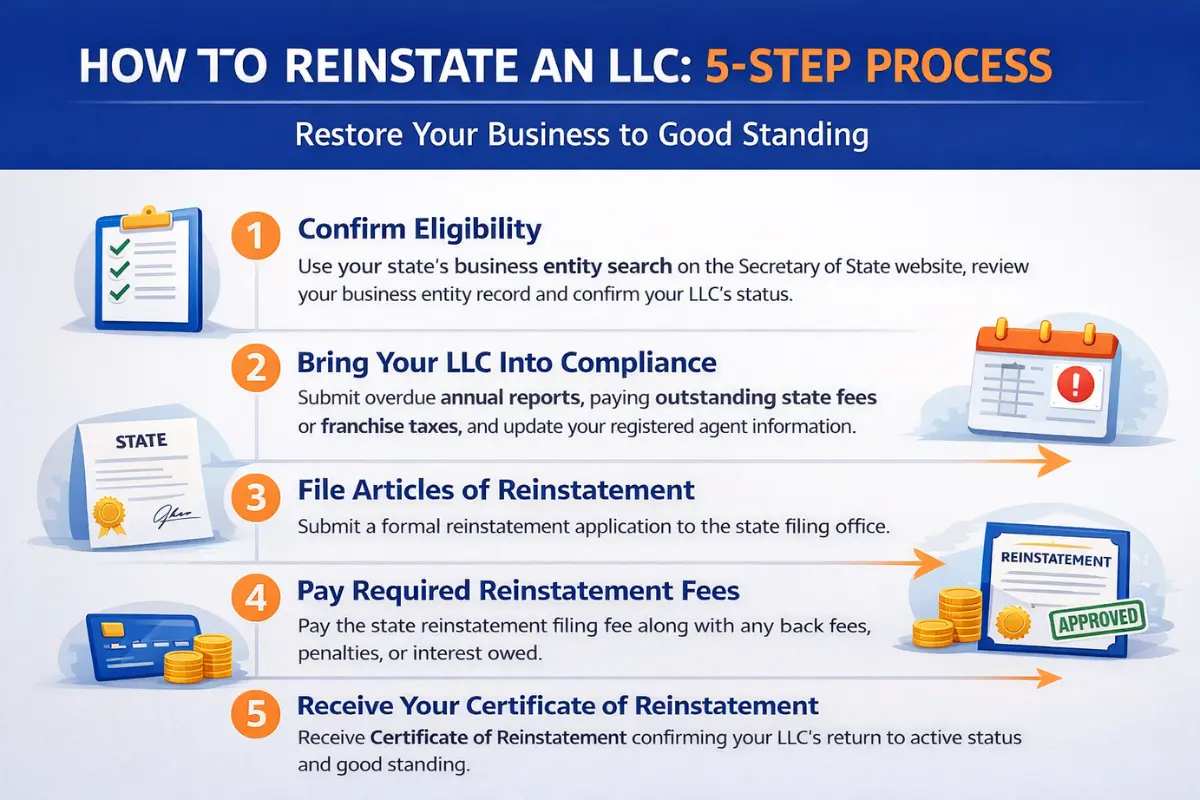
Every state has its own rules, but the process to reinstate a dissolved LLC generally follows the same steps.
Start by using your state’s business entity search on the Secretary of State website to review your business entity record and confirm your LLC’s status (active, dissolved, revoked, or forfeited). This will show any missing filings and help you determine whether you are still within the state’s reinstatement window. If too much time has passed, forming a new LLC may be required.
Before you file a reinstatement application, you must correct the issue that caused the administrative dissolution. This usually means submitting overdue annual reports, paying outstanding state fees or franchise taxes, and updating your registered agent information to restore your entity’s compliance.
Once compliance issues are resolved, you’ll submit a formal reinstatement application to the state filing office, often called Articles of Reinstatement or a Certificate of Revival. The form typically requires your LLC name, registration number, and confirmation that all deficiencies have been corrected.
You’ll need to pay the state reinstatement filing fee along with any back fees, penalties, or interest owed. Some states also offer expedited processing for an additional charge.
After approval, the state will issue a Certificate of Reinstatement confirming your LLC’s return to active status and good standing. Keep this document for your records, as banks, lenders, and contracting parties may request proof of reinstatement.
LLC reinstatement requirements vary by state, but most require filing a reinstatement application (often called Articles of Reinstatement) with the Secretary of State to change your business entity status from dissolved, revoked, or forfeited back to active.
In most cases, you must also:
File all overdue annual or biennial reports
Pay outstanding fees, penalties, and interest
Update registered agent information
Pay the required state reinstatement filing fee
Some states additionally require tax clearance or confirmation that franchise or business privilege taxes are current before restoring your LLC to good standing.
Reinstatement procedures vary widely. Some states allow a single online filing through the Secretary of State website, while others require paper submissions or additional agency approvals. In certain states, you may need to resolve tax issues with the state revenue department before your business entity record can be updated to active status.
Because requirements, fees, and processing times differ, reviewing your state’s specific reinstatement guidelines is essential.
Most states impose a reinstatement window, often one to five years from the date of administrative dissolution. If that deadline passes, reinstatement may no longer be available, and forming a new LLC may be required. This can result in losing your original business name, EIN history, and established contracts.
If your LLC’s entity status shows dissolved or inactive, confirm your eligibility as soon as possible and begin the reinstatement process before your window closes.
If you’re researching how to reinstate an LLC, the total cost will depend on your state, how long your LLC has been administratively dissolved, and what compliance issues must be resolved before filing a reinstatement application.
The cost to reinstate an LLC typically includes a state reinstatement filing fee, which can range from $25 to $500 depending on the state filing office. Some states charge a flat fee, while others calculate the amount based on how many annual reports were missed or how long the business entity status has been inactive. Certain states may also require payment of franchise taxes before restoring good standing.
If your LLC missed multiple annual or biennial reports, you’ll need to file each overdue report and pay any associated late fees, penalties, and accrued interest. In some states, penalties increase over time, meaning a multi-year lapse can significantly increase the total reinstatement cost.
If your administrative dissolution was triggered by a lapse in registered agent coverage, you may need to appoint a new registered agent before your reinstatement filing can be approved. Professional registered agent services typically range from $50 to $300 per year. Our team at MyLLC offers registered agent services as part of our business compliance solutions, allowing you to handle reinstatement and ongoing compliance in one place.
Processing times vary by state. If you file your reinstatement application online through the Secretary of State website, approval may take a few business days, especially with expedited processing. Paper filings submitted to the state filing office can take several weeks. Delays often occur if compliance issues or missing documents are not resolved before submission.
In many states, you can reinstate a dissolved LLC by submitting your reinstatement application through the Secretary of State’s online portal. While online filing is typically faster, it does not automatically correct missing annual reports, tax issues, or registered agent problems. If your administrative dissolution involves multiple deficiencies, additional steps may be required to restore your business entity status to active and return to good standing.
It depends on the state and how long the LLC has been inactive. Some states allow reinstatement years after dissolution; others have strict windows. If too much time has passed, forming a new LLC may be the only path forward. The IRS notes that "if you close your business, you must file a final tax return and take care of other required filings"—which applies equally when a business is dissolved involuntarily. This means tax obligations don't simply disappear with dissolution, and addressing them is a critical part of any reinstatement.
If your LLC has been dissolved for multiple years, we recommend reaching out to a professional before attempting reinstatement on your own. The compliance backlog alone can be complex, and missing a step can make the process take even longer.
Good standing means your LLC is current on all state requirements, with annual reports filed, fees paid, a registered agent on record, and no outstanding compliance issues. It's the status lenders, partners, and clients look for before doing business with you.
To restore your LLC to good standing after reinstatement, you'll need to:
File any remaining overdue reports
Pay all outstanding fees and penalties in full
Confirm your registered agent is active and properly designated
Receive and store your Certificate of Reinstatement
Set up a system to stay current going forward, using calendar reminders, a compliance service, or both.
Staying in good standing is much easier than recovering from dissolution. Once you're reinstated, build in the reminders and habits that keep you compliant year over year.
Reinstatement paperwork isn't complicated once you know what you're doing, but getting it wrong means delays, rejections, and more time without a legally active business. Our team has guided business owners through the reinstatement process nationwide, and we know what each state requires.
We handle everything from checking your eligibility and identifying outstanding compliance issues to filing your reinstatement documents and confirming your LLC is back in good standing. We also offer registered agent services, annual report filings, and ongoing compliance support so you never end up in this situation again.
If your LLC has been dissolved, don't wait. Contact MyLLC today to get started and let us get your business back where it belongs.
A dissolved LLC isn’t the end of your business, but it does require prompt action. Reinstating your LLC involves resolving compliance issues, filing the proper reinstatement application, paying outstanding fees, and obtaining your Certificate of Reinstatement to restore active status and good standing.
Because reinstatement rules, deadlines, and requirements vary by state, acting before your reinstatement window closes is critical. Working with a professional LLC reinstatement service helps ensure your filing is accurate, complete, and approved without unnecessary delays.
Costs vary by state but typically range from $25 to $500 in state filing fees alone. Add in back annual report fees, late penalties, and registered agent costs if applicable, and the total can range from a few hundred to over a thousand dollars depending on how long the LLC was dissolved and your state's fee structure.
This depends entirely on your state. Some states allow reinstatement within one year of dissolution; others extend the window to five years or more. A handful of states have no formal time limit, while others require you to form a new LLC if you miss their deadline. Check your state's Secretary of State website or contact our team to confirm your window.
In many states you can reinstate an LLC after years, but it often gets more costly and complicated. Expect multiple overdue reports and penalties, and note that some states cut off reinstatement after a certain time, so acting sooner is better.
If you don't reinstate your LLC, you risk losing liability protection, may not be able to enforce contracts under the LLC name, and could face frozen bank accounts or lost clients. The longer you wait, the more complex and expensive it can be to fix.
Yes. Once your LLC is marked administratively dissolved, it's inactive until you complete and the state approves a reinstatement filing. Acting quickly usually means fewer penalties, fewer missed reports, and a smoother process, so check your state's website and start reinstatement as soon as you can.
The effective date of reinstatement is usually the date the state approves and processes your application, not the original dissolution date. In some states, reinstatement is retroactive and your LLC is treated as if it never fell out of good standing; in others, it is not, so contracts and compliance during the dissolved period may be affected. Because rules differ by state, check how your state handles retroactive reinstatement before assuming your record is clear, and talk to a business attorney if you did business while dissolved and retroactive reinstatement is not available.