
What if I told you that moving your limited liability company to a different state could save you thousands of dollars every year, without dissolving your business, losing your EIN, or disrupting a single contract?
Most business owners don't realize they're stuck paying excessive franchise taxes and compliance fees simply because they formed their pass through entity in the wrong state. Operating in Texas but registered in New York? You're paying double what you should.
The solution isn't complicated, but most entrepreneurs have never heard of it. Re-domestication lets you completely relocate your LLC's legal home while maintaining your business identity, credit history, and operational continuity.
We're about to show you the exact process successful business owners use to escape unfavorable state laws, slash their tax bills, and simplify compliance, all without starting over from scratch.
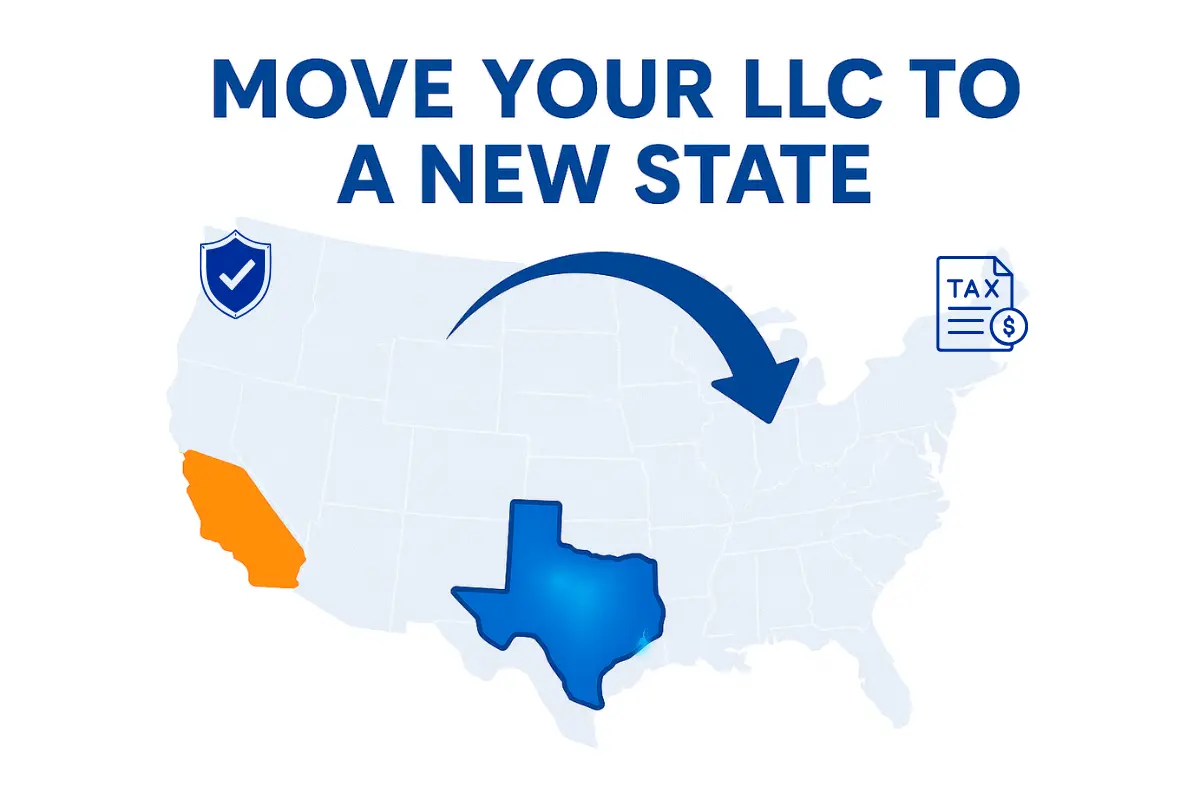
Re-domestication maintains business continuity: Your LLC stays the same legal entity with the same EIN, contracts, bank accounts, and business history. This prevents the disruption of dissolving and reforming.
Not all states allow domestication: Your destination state must explicitly permit inbound domestication. If it doesn't, you'll need to dissolve in your old state and form a new LLC, which is more complex and costly.
Articles of domestication are the core document: This filing officially transfers your LLC's charter from one state to another. Requirements vary significantly between states, so research your specific jurisdiction's forms.
Compliance never stops: After re-domestication, you'll follow your new state's annual report deadlines, franchise tax requirements, and registered agent rules. Missing these can put your good standing at risk.
Tax implications matter: Re-domestication can trigger state exit taxes or change your tax obligations. Consult with a tax professional before making the move to avoid unexpected bills.
LLC domestication is the legal process that transfers your company's official registration from one state to another while maintaining the same business entity. This limited liability company transition preserves your existing LLC's complete identity. According to SCORE, "Domestication is a legal process that shifts your company's charter to a new state, effectively changing its official residence while it continues as the same entity."
Think of it like updating your permanent address. Your LLC moves its legal home, but everything else stays intact, and your federal employer identification number, business bank accounts, existing contracts, and operational history all carry over seamlessly.
This differs fundamentally from foreign qualification, where you register to do business in another state while maintaining your original home state registration. With domestication, you're completely relocating your LLC's legal domicile.
Business owners consider re‑domestication for several strategic reasons that relate to state law, tax structure, and administration. Some states are known for relatively lower business‑related taxes and fees, while others impose higher minimum annual charges on LLCs, which can create an incentive to change the state of formation once a business’s operations are established elsewhere. When an owner or the company’s primary operations move to a new state, domesticating the LLC can align the legal structure with where the business is actually managed and conducts most of its activities.
Legal environment and administrative burdens also play important roles. Certain states, such as Delaware, are recognized for having specialized business courts and extensive business case law, which some owners and investors view as offering clearer rules and more predictable dispute resolution.
Operating an LLC that is formed in one state and registered as a foreign entity in one or more additional states can increase filing, reporting, and fee obligations, and domestication may reduce these overlapping compliance requirements.
Hypothetical examples, such as an owner moving an LLC from a high‑tax state to a state without a personal or corporate income tax, help illustrate possible benefits, but actual outcomes depend on the specific states and the business’s circumstances.
Understanding your options helps you choose the right path:
Domestication: Your existing LLC transfers its charter to a new state. The entity continues uninterrupted with the same EIN, ownership structure, and legal identity. This is the cleanest option when both states allow it.
Conversion: Similar to domestication but often involves changing entity types simultaneously, such as converting from an LLC to a corporation while moving states.
Dissolution and reformation: You close your LLC in the original state and create a brand new LLC in the destination state. Transferring an LLC this way means your old LLC ceases to exist in your charter state, and you start fresh. This requires a new EIN, new bank accounts, transferring assets, and potentially renegotiating contracts.
According to Forbes, "While any business can leave a state, not every state allows companies to re-domesticate into it; when that option is unavailable, owners may have to dissolve in the old state and form a new entity in the new state, which is usually more complex and expensive than straightforward domestication."
Foreign qualification: This isn't a relocation method at all. Foreign qualification (also called foreign registration) lets you operate in multiple states while your LLC remains domiciled in its original state. When you transact business across state lines, you'll file annual reports and pay fees in every state where you're qualified as a foreign entity.
The U.S. Small Business Administration explains that "Expanding into a new state often requires filing for foreign qualification there so the state formally recognizes your business and you remain compliant."
Re-domestication follows a specific sequence. Skip a step, and you risk compliance issues or rejected filings.
Verify domestication is possible before starting paperwork:
Check origin state requirements: Some states impose exit fees or require tax clearances. Review outbound domestication rules.
Confirm destination state accepts domestication: Wyoming, Delaware, Nevada, and Florida are examples of states that allow inbound domestication or similar conversion procedures. Other states may not offer domestication, in which case options such as dissolution and formation of a new LLC, a merger, or continued operation through foreign qualification may be required instead, depending on state law.
Review member approval requirements: Check your operating agreement for voting thresholds, which are typically based on majority or unanimous consent.
Understand tax impact: Some states may impose additional or accelerated state tax consequences when a business changes its state of formation or when its owners move, while others may not. Because the rules differ by state and depend on your specific situation, consult your accountant or another qualified tax professional before proceeding.
Articles of domestication officially transfer your LLC's charter. Required information typically includes:
Current LLC name and state of formation
New destination state
Registered agent in new state
Principal business address and new business address
Member/manager information (including all LLC members)
Each state has unique forms and filing requirements for domestication or conversion. Delaware requires a Certificate of Conversion; Wyoming uses Articles of Domestication. A professional formation service can help identify the correct documents, complete them with the required information, and submit them properly to reduce the risk of delays or rejections.
Filing coordinates both origin and destination states:
Obtain member approval: Document consent according to your operating agreement.
File with destination state: You can file the domestication or conversion documents and pay the state fees yourself with the new state’s filing office, but using a professional formation service is often more beneficial because they handle the correct forms, details, and submission steps, which helps reduce errors, delays, and potential rejections.
File withdrawal with origin state: Submit Certificate of Withdrawal, final tax returns, and any required clearances.
Fees vary: Wyoming’s domestication filing fee is roughly in the low hundreds of dollars, while many other states charge higher amounts. States commonly offer both standard and expedited processing at different price points.
After approval, update business records and notify relevant parties:
Obtain certificate: Your new state issues a certificate confirming domestication.
Update operating agreement: Amend to reflect new state and comply with new jurisdiction's laws.
Notify banks and creditors: Inform financial institutions about the jurisdiction change.
Update IRS records: In most domestications your EIN does not change, but you should notify the IRS of your new business address by filing Form 8822‑B.
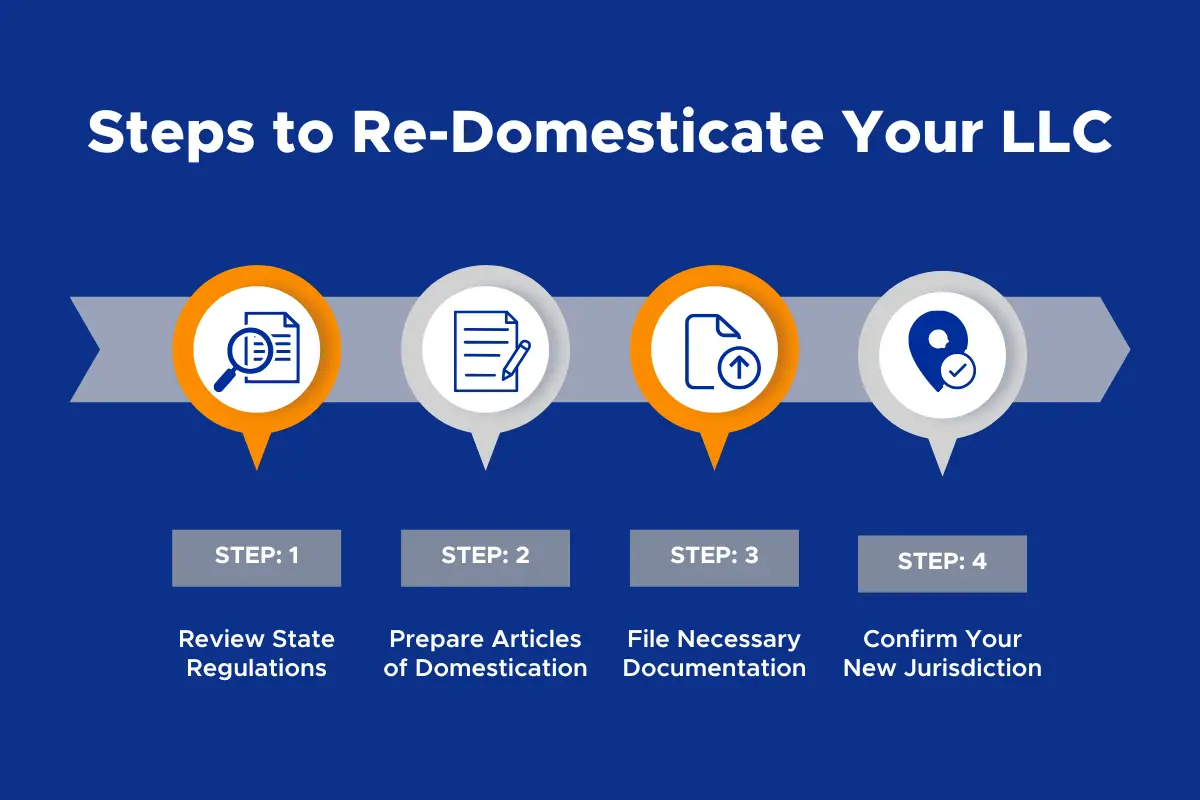
Each state sets its own rules for LLC domestication, so procedures and timelines are not uniform. Filing requirements can range from relatively simple forms to more detailed certificates that may need supporting documents such as resolutions or consents, and standard processing times commonly span from several business days to multiple weeks, with expedited options often available.
Your origin state may require additional steps before it will recognize a domestication or related withdrawal, such as providing a tax clearance certificate, a certificate of good standing, or satisfying any outstanding filings and fees. In most jurisdictions, your LLC must be in good standing for the domestication or withdrawal to be accepted, and the business registry (often the secretary of state) tracks whether annual reports, fees, and other obligations are current.
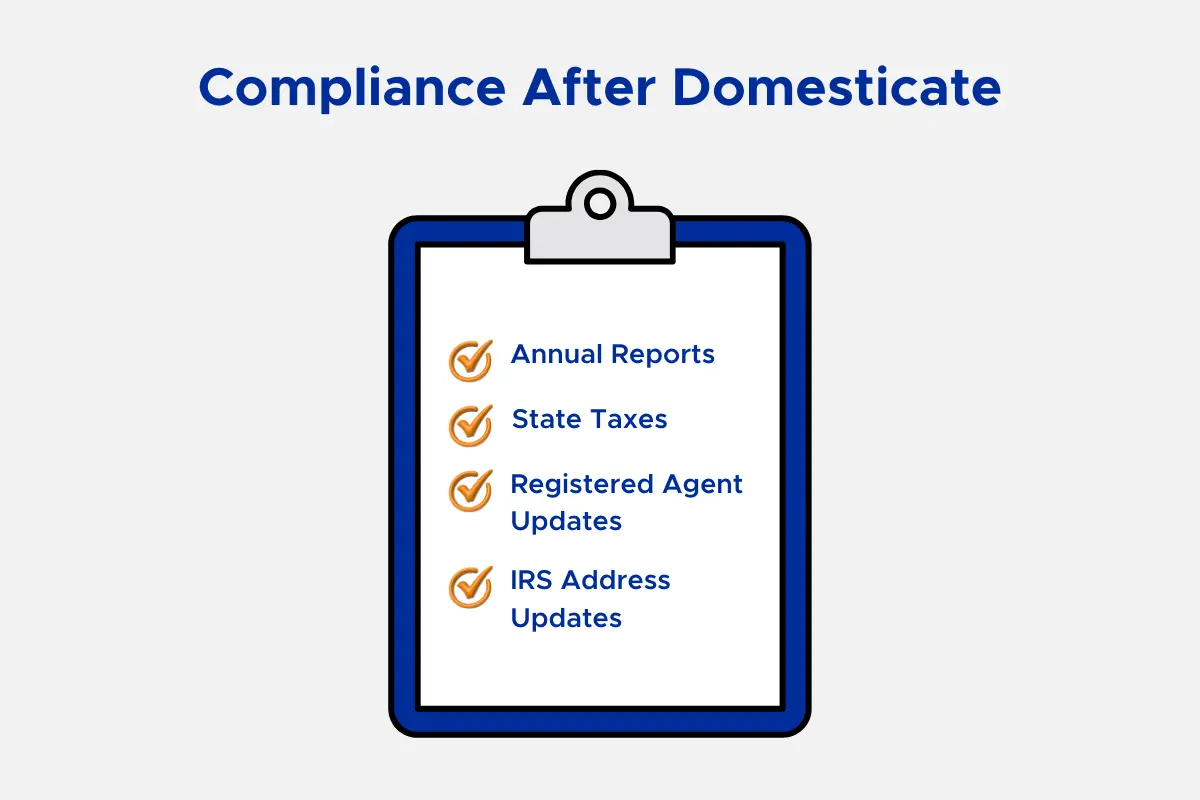
Once domestication is complete, your primary compliance obligations shift to the new state of formation, and you follow its rules for annual reports, taxes, and fees. For example, Wyoming LLC annual reports are generally due in the anniversary month of formation, while Delaware LLCs pay an annual LLC tax that is due on June 1 each year. You will typically pay ongoing franchise or similar state‑level fees to the new state instead of to the original state, assuming you are no longer registered there.
You must also maintain a registered agent in the new state on a continuous basis, since loss of a registered agent or failure to update that information can lead to administrative penalties or dissolution. Beyond that, staying current with all required state filings, fees, and record‑keeping is necessary to keep the LLC in good standing and avoid interruptions to business operations.
Not all states welcome domestication equally. Not every state permits inbound domestication, even if that's where your LLC was initially formed.
Business-friendly destinations:
Wyoming: No state income tax, strong privacy protections, and low annual fees make Wyoming popular for domestication. The process is straightforward with relatively quick processing times.
Delaware: Famous for its Court of Chancery and extensive business case law, Delaware attracts LLCs seeking legal predictability. The state offers clear statutes and experienced business courts.
Nevada: No corporate income tax, no franchise tax on income, and strong asset protection laws draw businesses to Nevada. Annual list and business license fees apply.
Florida: No state income tax and simple compliance requirements appeal to many LLC owners. Florida accepts domestication filings and processes them efficiently.
Texas: No state income tax, though franchise tax applies to most LLCs based on revenue. Texas welcomes domestication and offers a strong business infrastructure.
States with restrictions:
Some states either don't permit inbound domestication or make the process exceptionally difficult. California, Massachusetts, and New York have historically been less accommodating to domestication, though rules evolve. Always verify current state statutes before assuming domestication is impossible.
Each state offers unique advantages and requirements:
Wyoming: Strong charging order protection and no publication requirements mean lower costs and better asset protection.
Delaware: Complex franchise tax calculations and June 1st annual deadlines, but unmatched legal expertise and Court of Chancery precedents.
Nevada: Annual business license required alongside member list filing. Strong privacy, as the state does not share tax information with the IRS.
Texas: Franchise tax thresholds exclude many smaller LLCs from taxation. Good online filing systems and strong business infrastructure.
Re-domesticating your LLC maintains business continuity while giving you access to better laws, lower taxes, or simplified compliance. Understanding the steps involved will help you execute this transition smoothly. Follow these key steps:
Research thoroughly: Verify both states permit domestication and understand all costs including taxes and ongoing requirements. Determine what following documents you'll need.
Prepare accurate documents: Articles of domestication must be complete. Consider professional help for complex situations to ensure compliance with all regulations and detailed instructions from both states.
Maintain good standing: Resolve all compliance issues in your origin state before filing.
Update everything: Notify banks, update operating agreements, transfer licenses, and inform the IRS of address changes.
The right jurisdiction can save thousands annually while providing stronger protections. Research carefully, prepare documentation properly, and your transition will be smooth.
Processing times vary by state. Expedited filings complete in 2-3 business days in states like Nevada, while standard processing takes 2-6 weeks. The entire process from preparation to completion typically takes 4-8 weeks, including member approval and coordinating with both states.
No. Your federal EIN stays the same because you're maintaining the same legal entity. When you transfer one LLC from one state to another state, the EIN follows. This is a major advantage over dissolving and reforming in a different state. Update your address with the IRS using Form 8822-B after domestication. Your bank accounts, business credit, and contracts remain intact.
Not legally required, but professional guidance is recommended. Each state has unique requirements, and mistakes cause rejections. An operating agreement is an important internal document for LLCs, even if not required by law, as it helps protect your business and clarify member roles. Formation services handle paperwork accurately for less than attorney fees. Complex situations involving multi-member LLCs, substantial assets, statutory conversion, or unique tax circumstances benefit from consultation with a business attorney who understands your specific needs.
Licenses don't automatically transfer. Research your new state's requirements and potentially surrender old state licenses. Professional licenses and industry-specific permits need individual attention. Start early as some permits have waiting periods. Your LLC can operate during transition if you maintain necessary authorizations.
No. Your destination state must allow inbound domestication. Wyoming, Delaware, Nevada, Florida, and Texas welcome domestications. If your desired state doesn't permit it, you'll need to dissolve and reform as a new LLC, which is more complex and costly. Verify current state laws before starting.
Costs vary significantly. Filing fees range from $100-$500. Add registered agent fees ($50-$300 annually), expedited processing ($50-$200), and professional services ($300-$1,500). Some states impose exit fees or require dissolution paperwork for your old state. You'll need to determine if there are remaining assets to transfer. Budget $500-$2,000 total for straightforward domestications. Complex situations involving operations in other states may cost more.
Foreign qualification lets you operate in multiple states while maintaining your original formation state. Your current LLC stays registered in one state as its home base. Domestication completely relocates your LLC's legal home. When you transfer LLC operations from one state to another through domestication, you're moving your entire business entity. With foreign qualification, you file annual reports in every qualified state. With domestication, you only maintain registration in your new home state.
Yes, amend it to reflect your new state of organization. Requirements vary depending on the old and new states involved. Some provisions may need updates to comply with new state laws and specific requirements. Review voting, profit distribution, and dissolution clauses. Different states have different default LLC rules, so provisions optional in your old state might be mandatory in your new one. You may also need to file articles of organization or similar formation documents in your destination state.
Re-domesticating involves navigating complex regulations and tight deadlines. One mistake can delay filings or leave you non-compliant.
We handle the entire process, researching requirements, preparing articles of domestication, coordinating state filings, and ensuring ongoing compliance. We also provide registered agent services in all 50 states and annual report assistance.
Contact us today to make your state transition seamless and stress-free.